
How we tested earplugs.
This page covers the method behind Investigation No. 2. It is not, we should say immediately, a light read. But then neither is buying the wrong earplugs.
Eight sensory axes. Six environments. This is how we tested for autistic adults, people with sensory processing disorder, misophonia, and anyone for whom standard earplug reviews answer the wrong questions.
Whether you have autism, sensory processing disorder (SPD), misophonia, ADHD, or you are simply a person who finds noise physically difficult, you likely need earplugs for different reasons at different times. The right product for recovering from sensory overload in a quiet room is not the right product for staying present in a meeting. No single review covers all three.
On this page
The problem with existing earplug reviews
Why these tests are different
Standard earplug reviews answer one question: how much noise does it reduce? The answer comes as a single number, NRR or SNR, measured in a laboratory under ideal conditions. Then the review ends.
For autistic adults, people with sensory processing disorder, or anyone with misophonia, that number answers almost nothing useful. An earplug does not just reduce sound. It changes what you hear of your own body. It creates pressure inside the ear canal that builds over sixty minutes in ways it did not at five. It interacts with how your nervous system manages input over sustained wear. It has hygiene implications for people with disgust sensitivity. It has social visibility implications. And depending on the product, it may make the sensory experience worse rather than better — adding new unwanted input at the same time as it reduces existing input.
An earplug that adequately attenuates external noise can still be a net negative experience. This happens more than the packaging suggests.
This investigation was conducted by one sensory-sensitive adult tester with a smaller-than-average ear canal, across six real-world environments, over multiple sessions per product. Ten products were tested. No manufacturer saw findings before publication. No product was paid to be included.
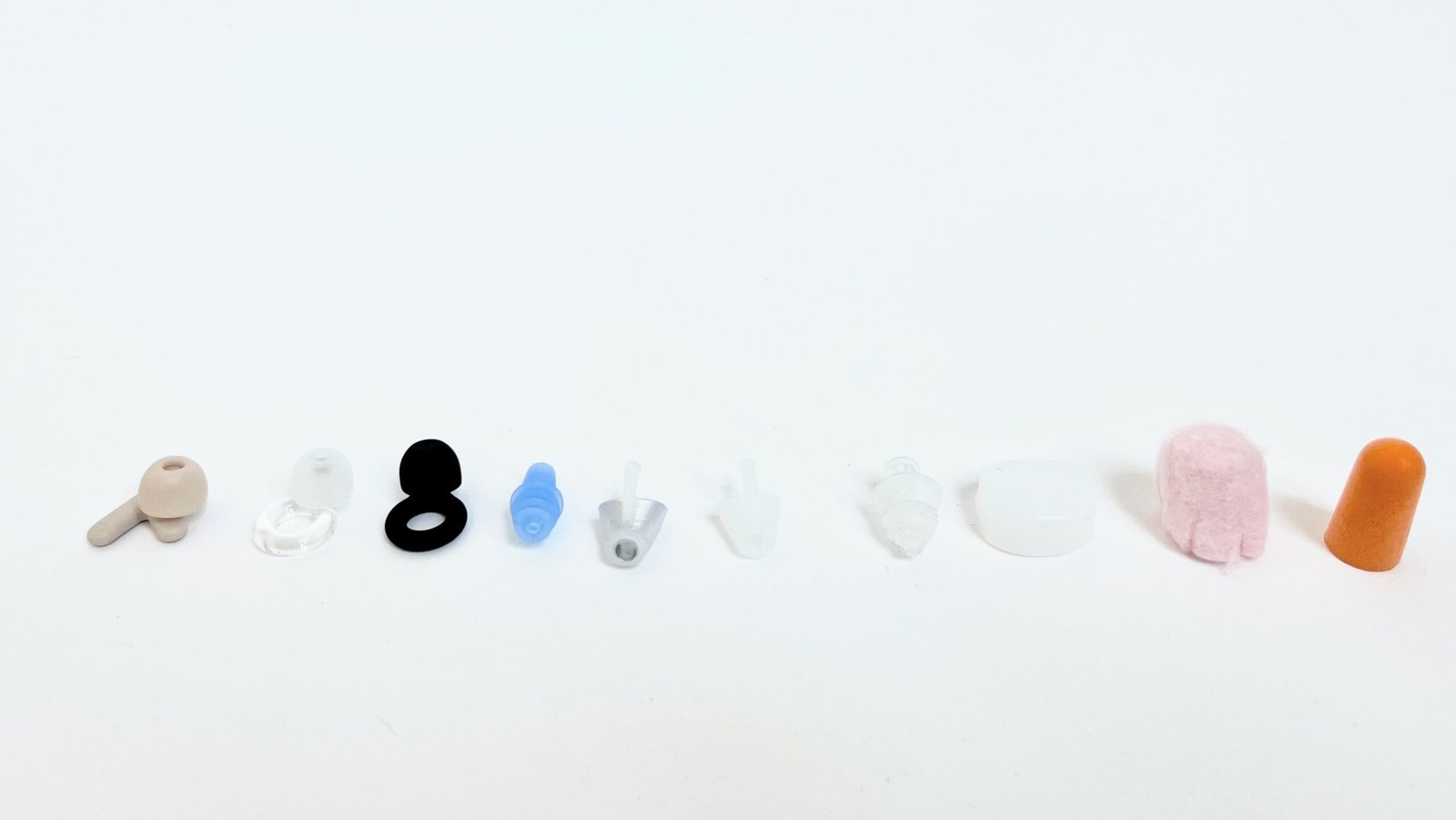
Fig. II — All ten products. Foam, silicone, wax, and hollow resonance modifier. Not to be confused with each other.
In the US, earplugs carry an NRR (Noise Reduction Rating) measured in laboratory conditions. OSHA recommends halving the NRR figure to estimate real-world performance: NRR 33 becomes approximately 16dB of usable protection in practice.
In the UK and Europe, the equivalent figure is SNR (Single Number Rating), which uses a different measurement standard. The UK’s HSE applies a further correction of -4dB to SNR for real-world estimates.
This investigation uses SNR where available, NRR where not. The ratings appear in each Case File but are not the primary finding. Real-world attenuation character, occlusion effect, and sustained comfort are. Neither NRR nor SNR predicts how an earplug will feel to a sensory-sensitive wearer.
Six dimensions, scored independently
The sensory axes

Every Case File scores each product across six dimensions independently. A product can be excellent on noise and a problem on feel at the same time. A verdict that combines those findings into a single number does not give you enough to go on, so we do not produce one.
The three primary axes carry the most editorial weight for earplugs. The three secondary axes are documented where relevant but rarely determine the verdict on their own.
Secondary axes — documented, rarely verdict-determining:
Noise — what this axis actually covers
The Noise axis covers four phenomena. Each is independent of the others.
Attenuation character. Not how much noise is reduced, but what kind of reduction. Three different mechanisms appear in this investigation: volume reduction (everything proportionally quieter, as with foam and wax); frequency filtering (specific frequencies reduced while speech is preserved, as with hi-fi filter products); resonance modification (no volume reduction, but the character of harsh frequencies is altered, as with the Flare Calmer range). A single NRR number describes none of this.
Occlusion effect. When the ear canal is sealed, bone-conducted sounds including your own voice, heartbeat, breathing, chewing, and footsteps are amplified at low frequencies. For autistic adults and people with sensory processing disorder, interoceptive hypersensitivity means this amplification is not background noise. It is a foreground event that does not fade. Full explanation in the occlusion section below.
Over-attenuation. The removal of too much, including the ambient noise floor that many sensory-sensitive adults use unconsciously as an environmental anchor. A January 2026 study in Audiology Research documented measurable anxiety increases in healthy adults from two hours of continuous earplug wear.
Speech intelligibility. Can you hear a cashier? A bus announcement? A dining companion? Tested at one metre in each relevant environment. Particularly relevant for people with auditory processing disorder, where speech clarity in noise is the primary concern.
Feel — pressure, insertion, and the piston effect
The piston effect. When a flanged or wax earplug seals the ear canal before reaching its final position, it traps a column of air between the plug face and the eardrum. Further inward movement compresses that column. The eardrum, the only compliant surface at the closed end, deflects inward under the pressure. This is documented in acoustic engineering literature as the piston effect.
Flanged silicone products like Loop Quiet 2 and Loop Engage produce this progressively as each flange seats. Wax produces it when pressed inward to improve the seal. Open-cell foam like the 3M 1100 does not produce it at all. The interconnected cell structure allows air to migrate through the plug body. No airtight column forms.
In a smaller-than-average ear canal, the same insertion movement compresses a smaller initial air volume, producing proportionally greater pressure. This relationship is not documented in consumer earplug literature in relation to canal anatomy. It is documented here, across ten products.
Canal safety. The risk that part of a product becomes lodged in the canal is real and was documented during this investigation. Products where this risk exists are flagged explicitly in the Case File.
Hygiene — pathogen-related disgust sensitivity
The aversion to products that look contaminated, degrade visibly, or are difficult to clean is documented in the clinical literature as pathogen-related disgust sensitivity. A 2023 review in Current Psychiatry Reports notes that disgust processing differences in autistic populations are routinely conflated with other sensory findings and understudied.
Foam plugs discolour and deform. Silicone accumulates earwax in a way that is visible and not entirely removable. Wax softens and merges with skin debris. Whether you would comfortably reinsert a product after removing it, and whether it remains visually acceptable after a week of daily use, is a real usability question that no mainstream earplug review documents.
Where each product was tested
Test environments
Every product was tested across six environments chosen for their relevance to daily ND noise management. An A-road test was initially planned and dropped. Broadband outdoor traffic noise is largely covered by the bus stage, and standing at a roadside adds logistical complexity without adding editorial content for an audience whose primary noise problems are indoors.
S1 — Quiet room (baseline)
No appliances. Sit still. Tests occlusion effect without ambient masking: own-voice, heartbeat, breathing, footstep thud, own-chewing. Over-attenuation. Canal safety. Piston effect on insertion and removal. Small canal anatomy observations. Run first for every product, without exception. The most important stage for sensory-sensitive adults, because it isolates the sounds earplugs add rather than the sounds they remove.
S2 — Home, appliances running
Kettle at one metre, extractor fan, washing machine on spin. Tests frequency-specific attenuation across the ranges most relevant to daily home noise. Controlled enough for consistent cross-product comparison. Includes the volume-versus-character distinction test: does the earplug make sound quieter, or does it change the quality of the sound?
S3 — Bus
Upper deck, peak hours. Engine and road noise through the floor, passenger voices, phone audio, PA announcements. Situational awareness test: can you hear your stop called? Social visibility. On/off practicality when needing to speak to another person.
S4 — Supermarket
Medium-large store, busy period. PA announcements, checkout beeps, HVAC and refrigeration hum, background music, trolley impacts. Tests over-attenuation specifically: whether the ambient noise floor used as a grounding anchor by people with autism or SPD is stripped away by high-attenuation products.
S5 — Office, open plan
Keyboard noise, one-sided phone calls from adjacent desks, HVAC, desk eating sounds. Extended wear at 60 minutes. On/off cycle practicality. Whether a colleague would notice, and whether they would say anything. Particularly relevant for autistic adults and people with ADHD managing a full working day.
S6 — Restaurant or café (misophonia context)
Nearby chewing, cutlery on plates, background music. Tests the volume-versus-character distinction for the sounds most frequently cited in misophonia discussions: does the product remove the sharp attack of cutlery, or just make it quieter? Whether the product makes a restaurant visit more viable, or merely quieter in a way that also makes conversation impossible.
+ Hygiene — after 5 or more uses
Not an environment. A time-based assessment after repeated use across the above stages. Visual degradation, cleaning process, reinsertion comfort, and disgust response over time.
The failure mode most reviews miss
Why wear duration matters
Most earplug reviews test products for the time it takes to form an impression. This misses the failure modes that matter most for daily ND use. Products that feel tolerable at fifteen minutes often fail at sixty, and that failure is typically not acoustic. It is neurological: cognitive fatigue, irritability, a sense of depletion even though the acoustic environment was better managed than usual. This pattern appears consistently in ND community discussions on Reddit (r/autism, r/AutisticAdults, r/LoopEarplugs, r/misophonia) even when reviewers do not use explicit duration language.
| Checkpoint | What it surfaces |
|---|---|
| 0 to 5 min | The abort threshold. Canal safety anxiety, occlusion shock, and own-voice distortion all peak at first contact. Many sensory-sensitive adults, including autistic people and those with SPD, stop here and never find out whether the product would have worked at thirty minutes. |
| 15 min | First pressure and occlusion habituation, or failure to habituate. The beginning of build-up for products that will later become uncomfortable. |
| 30 min | The daily task threshold. A supermarket trip, a short meeting, a bus journey. Products that pass here are viable for occasional use. |
| 60 min | The desk work and extended commute threshold. Where cognitive fatigue begins to separate acoustically adequate products from neurologically tolerable ones. The most under-tested duration in mainstream reviews, and the one most discussed in ND forums. |
| 2 to 4 hrs | Extended wear, tested for one product per material class: foam (3M 1100), silicone (Loop Quiet 2), wax (Ohropax). Defines the upper boundary of practical daily use. |
| Post-removal | Sound rebound and nervous system recovery. Whether the world feels suddenly too loud after removal. Whether any sense of depletion persists fifteen minutes later. Documented for every product. |
A product can succeed acoustically while failing neurologically. These are independent variables. Both are reported.
Tested at nine frequencies
Frequency perception testing
Standard NRR and SNR ratings collapse all frequency performance into one number. That number cannot tell you whether a product attenuates checkout beeps differently from the human voice range, or whether it removes the high-frequency sharpness that triggers misophonia while leaving speech intelligibility intact. For autistic adults and people with sensory processing disorder, this distinction is often the most important thing to know about an earplug.
Every product in this investigation was tested against nine specific frequencies, chosen because they map to the daily sounds most frequently cited as triggers or concerns in ND community discussion.
| Frequency | What it represents | Why it matters |
|---|---|---|
| 75 Hz | Traffic rumble, HVAC low end | The grounding hum — ambient floor used for environmental orientation in autism and SPD |
| 125 Hz | Traffic rumble, HVAC | Low-frequency baseline — constant daily presence |
| 250 Hz | Bus engine, fridge hum | Common daily background |
| 500 Hz | Chewing low end, voice fundamentals | Misophonia and speech range — overlapping and significant |
| 1 kHz | Speech clarity centre | Core conversation frequency — intelligibility depends on this. Key for auditory processing disorder. |
| 2 kHz | Checkout beeps, start of Calmer’s claimed range | Key ND irritant range |
| 4 kHz | Kettle hiss, cutlery click, PA tones | High-frequency triggers — sharpest daily sounds, most common misophonia triggers |
| 8 kHz | Sibilance, sharpness | Where “harsh” quality originates in most daily noise |
| 15 kHz | Extreme high frequency | The sharp squeal that produces a physical response in some people with sensory sensitivity |
Tones played through a NAD C320 amplifier connected to B&W S601 speakers at a fixed volume (33% of maximum) and distance (50cm). Same listening position for every product. For each frequency: tone played once without earplugs, once with the product inserted. Results expressed as percentage of perceived signal. 100% means fully audible at the same level as without earplugs. 0% means inaudible.
The 15kHz tone used an iPhone speaker at maximum volume at six-inch distance; the B&W speakers could not produce sufficient output at this frequency at the test volume. 15kHz results are not directly comparable to the other eight and are marked as such in the data.
This is perceptual data from one tester. It tells you what these products do to specific sounds. It does not replicate laboratory insertion loss testing.
- Loop Quiet 2 — frequency data
- Loop Engage — frequency data
- Flare Calmer Mini — frequency data
- Flare Calmer Pro Mini — frequency data
- Alpine PartyPlug — frequency data
- Alpine Silence — frequency data
- Mack’s Pillow Soft — frequency data
- Ohropax Classic Wax — frequency data
- 3M 1100 — frequency data
- EarPlanes Small — frequency data
The dimension all other reviews ignore
Occlusion effect measurement
The occlusion effect is the amplification of bone-conducted sound — your own heartbeat, voice, breathing, and chewing — that occurs when the ear canal is sealed. It is the most important dimension in this investigation. It is also the one most completely absent from consumer earplug coverage, which is curious given that it is the most common reason people in ND communities say they stopped using earplugs they could not fault acoustically.
What the occlusion effect is
Sound reaches the inner ear through two pathways simultaneously. Air conduction carries sound through the air and to the eardrum. Bone conduction carries sound directly through the skull to the cochlea, bypassing the air entirely. This is how you hear your own voice, heartbeat, and chewing.
In an open ear canal, bone-conducted sound partially radiates outward and dissipates. When the canal is sealed, that release valve closes. Low-frequency bone-conducted energy reflects between the plug face and the eardrum, building pressure in the sealed cavity. The eardrum receives both the normal vibration and the amplified reflected version. Subjectively: your voice sounds hollow or boomy, footsteps thud inside your skull, and in a quiet room you can hear your own heartbeat. These are documented in peer-reviewed acoustic literature.
Different seal types produce different magnitudes. Deep-insertion foam produces the strongest occlusion effect. Wax, sealing at the entrance and leaving the full canal length as cavity, produces measurably less. The Flare Calmer, hollow and non-occluding, produces none by design.
Why this is specifically a problem for autistic people and those with SPD
Interoceptive hypersensitivity. Interoception, the sense of your own body, is documented as differing in many autistic adults, with heightened sensitivity to internal signals. The occlusion effect amplifies the sounds of your own body. For someone with typical interoception, hearing their own heartbeat is mildly annoying and fades in seconds. For an autistic adult or someone with sensory processing disorder, it is a foreground event that does not fade.
Sensory gating. The neurotypical brain automatically filters sensory input, deciding what is signal and what is background. Research on autism documents reduced automatic filtering. The occlusion-amplified heartbeat stays foregrounded, competing for processing with whatever the person is trying to attend to.
The control problem. Earplugs are used as a sensory management tool, a way to increase control over the acoustic environment. The occlusion effect does the opposite at the moment of insertion. For many autistic adults, an unexpected sensory event is distressing independent of its intensity. Further reading: National Autistic Society — Sensory differences
How we measured it — the contact transducer method
Measuring the occlusion effect properly requires a probe microphone placed inside the ear canal alongside the earplug. That equipment is used by audiologists and costs thousands of pounds. The subjective experience is documentable through a consistent semi-objective method using a contact transducer.
Equipment: Headway “The Band” contact transducer (1/4″ output) clamped to the mastoid bone (the bony surface directly behind the ear). Fishman Model G preamplifier for consistent gain staging. USB audio interface (LINE IN). Audacity for spectrum analysis.
Method: Transducer fixed to the mastoid at a consistent position marked between sessions. Tester hums a fixed pitch, verified against a tuning app, for ten seconds without earplug. This is the baseline. Earplug inserted. Same pitch hummed again. In Audacity’s spectrum analyser, the occlusion effect appears as elevated energy in the 100 to 1000Hz band. Products with high occlusion effect show a pronounced low-frequency hump. The Flare Calmer shows essentially no difference from baseline.
This is not laboratory measurement. It produces consistent comparative spectral profiles across products, under identical conditions, by the same tester and signal chain. For the established laboratory method: Occlusion effect: A review, JASA 2022.
What the labels say
How we checked the claims
Before testing any product, every claim on the packaging and website was recorded verbatim. Each was assessed as testable, partially testable, vague, or unverifiable. Then tested.
The NRR and SNR ratings require a specific note. Both are measured in laboratory conditions with perfect insertion by a trained experimenter on subjects with standard anatomy. The UK Health and Safety Executive recommends subtracting 4dB from any stated SNR for real-world estimates. OSHA recommends a 50% correction factor applied to NRR: an NRR-37 earplug delivers approximately 13dB of real-world protection, not 37dB. Every Case File states both the rated figure and the estimated real-world figure.
The rated figure is what happens in a laboratory with a trained experimenter. BOST describes what happens in a supermarket with a sensory-sensitive adult. Both are useful. Neither replaces the other.
Claims assessed as unverifiable, including Flare Audio’s assertion that all other earplugs increase ear sensitivity over time, are stated as such with a note that no clinical citation was provided. This is accurate description of the claim. It is not a negative verdict on the product.
- UK HSE — Hearing protection and SNR derating
- OSHA Appendix B — NRR derating methods
- Occlusion effect: A review — JASA 2022
- Levy & Weisler — Anxiety and mood effects of sustained earplug wear, Audiology Research 2026
- Disgust processing differences in autistic populations — Current Psychiatry Reports 2023
- National Autistic Society — Sensory differences in autism
How to read the findings
What the verdicts mean
Every Case File ends with one of three verdicts. Verdicts always say what they apply to, because a product can be Cleared for one sensory profile and Flagged for another at the same time.
The overall verdict is a summary. The six-axis scorecard is the thing. It tells you which dimensions to attend to given your specific sensitivities and use case.
Investigation No. 2 — all ten Case Files
Read the reviews
Ohropax Classic Wax — wax, entrance seal
Loop Quiet 2 — silicone flanged, SNR 24
Loop Engage — silicone flanged, SNR 16
Flare Calmer Mini — hollow silicone, resonance modifier, zero occlusion
Flare Calmer Pro Mini — aluminium core variant
Alpine PartyPlug — concert plug tested for daily survival
Alpine Silence — XS to L sizes
3M 1100 — industrial foam, NRR 37, lateral test
EarPlanes Small — pressure regulation, lateral test
Investigation No. 1 — how shampoos are tested
A third testing methodology is now live which covers noise cancelling headphones for sensory-sensitive adults, which face a different set of sensory problems, including the pressure sensation that heavy cancellation can produce.