
EarPlanes Earplugs: Sensory Review (Lateral Test)
A flight pressure plug that, tested on the ground and outside its intended use, gave almost no noise relief in any daily environment. The tone test promised something the real world withheld.
Case report within Investigation No. 2, run as a lateral test. Six daily environments. The flight / cabin-pressure use was not tested. Subjective impressions, not laboratory measurement.
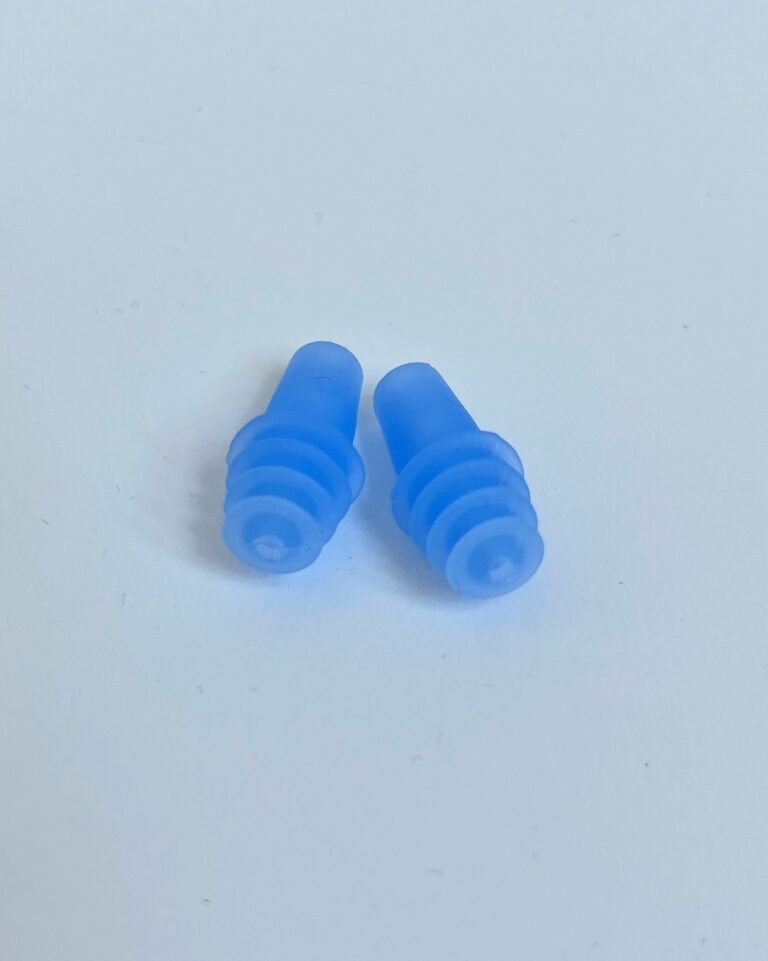
EarPlanes Small. Designed for flights. Tested on the ground.
The cafe was one of those chain places that commits fully to hard surfaces, harsh lighting, and music loud enough to feel personal. People eating, chatting, laughing. The plugs went in, with some hope of relief. Ten minutes later they came out. And went back in. And came out again. After ten minutes of that, the conclusion was unavoidable: nothing had changed. The flight pressure plug had no help to offer on the ground.
Sensory Scorecard

What these eight axes mean
- Noise
- External sound, unpredictable or unfiltered. Includes misophonia triggers.
- Scent
- Smell that registers as invasive. Lingers and transfers.
- Tactile
- Surface contact on skin and in the ear: texture, friction, residue.
- Proprioceptive
- Physical pressure and the sense of something seated in the ear.
- Interoception
- Internal body signals the seal amplifies: heartbeat, breathing, pulse.
- Visual
- How the product looks; light, pattern, or appearance factors.
- Hygiene
- Contamination sensitivity: cleanliness, residue, the look of the product.
- Social
- Other people as a sensory source, plus the social cost of wearing it.
✗ Noise
Almost no attenuation in any live environment, despite a tone test that showed promise. On the ground it gave nothing.
The tone test told one story and live testing told another, and the live rooms were right. On the bench the figures looked competitive at a couple of frequencies, 45% through at 250Hz and 40% at 4kHz, close to Loop Engage, numbers that should soften a supermarket or an office. In practice, across the bus, the supermarket, the office, and the cafe, the attenuation was almost undetectable: engine noise at full volume, PA announcements unchanged, desk-eating sounds unaffected. The reason is the ceramic filter, which is built to slow rapid pressure changes, not to block steady continuous noise; under sustained sound the microporous ceramic simply lets pressure equilibrate and the sound comes through. It does its actual job, which is the flight job, and that job was not tested here. The mechanism context for sealed-ear effects is on the occlusion effect explained, and the bench figures behind that gap come from the nine-tone process set out in how these earplugs were tested for sensory sensitivity.
✓ Scent
Absent.
– Tactile
Dry, resistant insertion and a pressure that builds from 5 to 10 minutes, despite the filter design.
The multiple-flange design needed more force on insertion than any other silicone plug here, and because the silicone is dry rather than soft, twisting and pressing produced friction against the canal wall rather than a gradual adaptive seat. The deep seating required for any effect was a constant low-level concern, more so in a smaller canal. Then the irony: at 5 to 10 minutes pressure builds, and on the bus that became a popping sensation more distracting than the sound it was supposed to address. The product claims to moderate pressure change, and may well do so in a flight’s rapid descent, but in sustained sealed daily wear the pressure accumulated rather than equalised.
✓ Hygiene
Stays clean and shows no degradation, though the maker recommends a short life.
After multiple uses the matte blue silicone shows no degradation, wax, or discolouration, and wipes clean easily. A strong area of performance and not at all triggering. The caveat is the maker’s own: disposal recommended after two flights, due to the ceramic filter accumulating moisture and particles, which in daily use is roughly four wears, a shorter life than other silicone plugs. Whether the filter meaningfully degrades before then in non-flight conditions wasn’t confirmed by testing. Wouldn’t be shared without sterilising.
– Proprioceptive
The canal feels occupied rather than sealed, a dry, lodged sensation that pressure undercuts over time.
Once seated it stays put, with no shifting on the bus or in the shop, but the sensation is of something occupying the canal at a greater depth than is comfortable, a lodged feeling rather than a settled one. The dry silicone left an itching, drying sensation in the canal, unlike the wetter sealing comfort of softer plugs. At 60 minutes at a desk this turned into a consistent desire to remove them: not painful, but not tolerable for a full working day.
✓ Interoception
The lowest internal-body intrusion in the whole investigation: the genuine, narrow upside.
This is the one place EarPlanes wins, and it wins clearly. Because so little is sealed, the inward amplification that makes other plugs hard to bear is almost absent: no heartbeat, breathing barely raised, no footstep thud, own chewing only slightly louder. For someone whose sole problem is occlusion rather than noise, these would be the least intrusive plug in the set. The catch is that very few people wearing earplugs have no need to attenuate anything. The mechanism is covered on the occlusion effect explained.
– Social
Socially invisible and easy to talk in, because it barely changes what you hear.
On the social axis these read as neutral-to-fine, but for a hollow reason. They’re invisible enough to wear anywhere and you can talk freely with them in, because they change so little of what reaches you. There’s no isolation and no awkwardness. But the point of a sensory plug in a social setting is to take the edge off the surrounding noise so you can stay, and that’s the one thing these don’t do. For a socially invisible plug that actually softens the room, the Alpine PartyPlug is the one to reach for.
Frequency Perception
% = signal allowed through. Lower = stronger attenuation. Tone generator (NAD C320 / B&W S601, 33% volume, 50cm). 15kHz via iPhone at 6 inches. Subjective perception, not laboratory measurement.
What the Testing Showed

BOST didn’t test a flight plug for daily noise out of ignorance. The starting point of every investigation is that what a company promises and what a product delivers rarely match, sometimes for the worse, sometimes pleasantly for the better, and the only way to know which is to test. Surviving an overstimulating world runs on ingenuity and constant small hacks, so part of BOST’s brief is to take the unusual solution and see whether it holds up against a difficult problem.
The CeramX ceramic filter is a genuine piece of engineering: it lets air through microscopic pores at a slow, controlled rate, so a flight’s rapid descent reaches the eardrum gradually rather than all at once. That is a specific mechanism for a specific problem, and it is not a noise-attenuation mechanism. The flight job was not tested here, and nothing in this review confirms or denies it.
That promise sat in the tone test, which passed 45% at 250Hz and 40% at 4kHz, close to Loop Engage at that band, numbers that ought to soften a real room. They didn’t. Across the bus, the supermarket, the office, and the cafe, the reduction was almost undetectable, the bench and the live rooms telling contradictory stories with the live rooms winning. The reason is porosity: blow through the EarPlanes and almost nothing passes, where the same breath moves freely through the Alpine PartyPlug. The ceramic is too slow and too fine for sustained ambient noise to be attenuated, even where a brief test tone is.
So, tested on the ground and outside its intended use, it’s flagged. There’s one honest upside, the lowest occlusion in the whole investigation, which would matter to someone whose only concern is their own voice and not the noise around them, a narrow case. And one real downside beyond the noise: pressure that builds from 5 to 10 minutes into a popping sensation, ironic in a product sold to manage ear pressure. For the air-permeable design done well, and cleared for daily use, the Alpine PartyPlug is the direct comparison.
What this product is
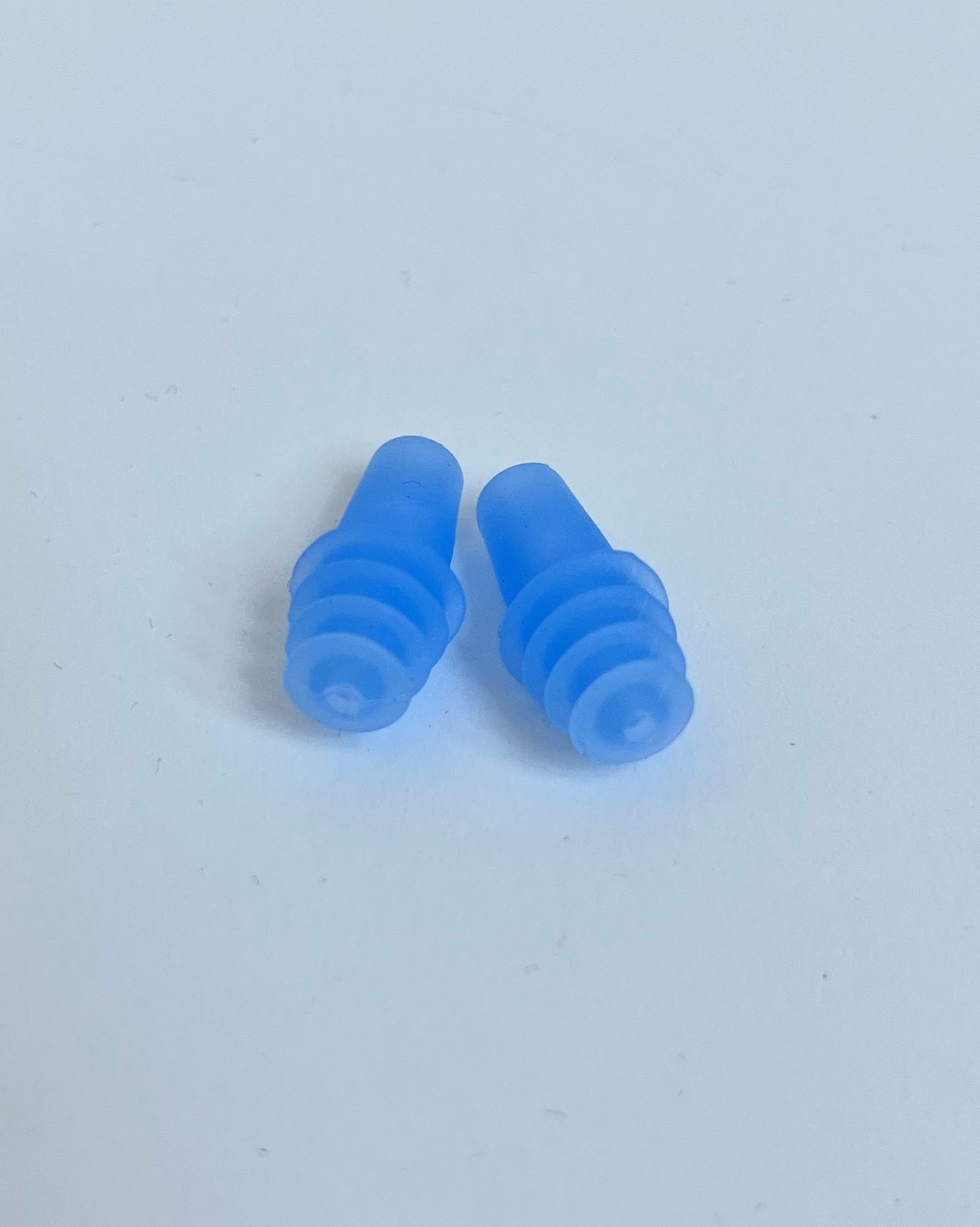
- One-piece silicone body — – the whole device is a single moulded unit of matte blue silicone, not a tip-and-stem build, with a multiple-flange profile that means heavy contact resistance on insertion
- CeramX ceramic filter — – a microporous ceramic disc inside the hollow core, tuned to let air equalise slowly so cabin-pressure changes reach the eardrum gradually; this is the flight mechanism, and it is not a noise-blocking one
- Hollow core — – lets air move slowly through, which removes the piston effect but, in daily noise, also lets sustained sound pass
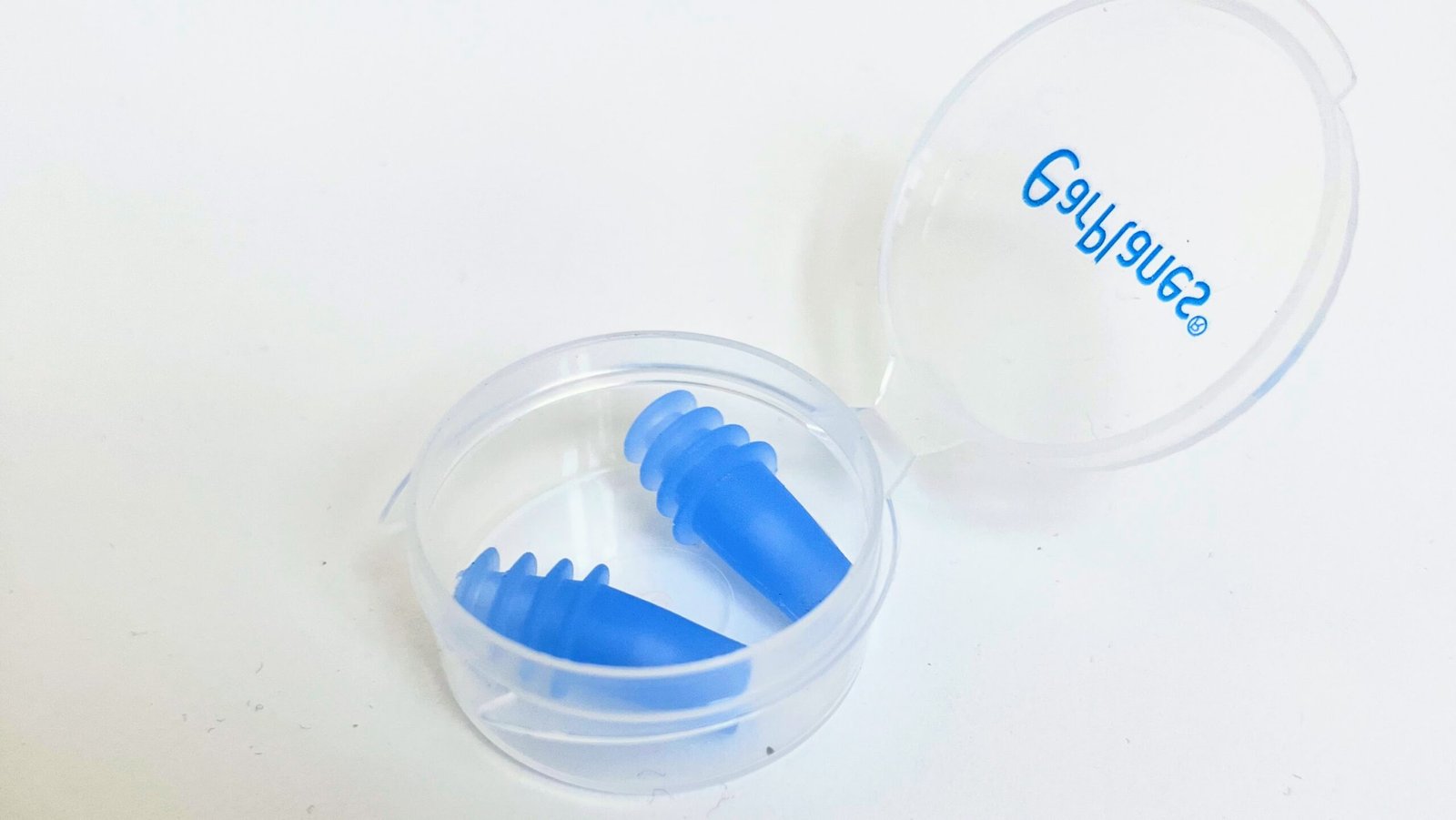
- Round travel case — – the most compact case in the investigation, hard and snap-closed; note the outer box arrived unsealed
The Investigation

First Impressions
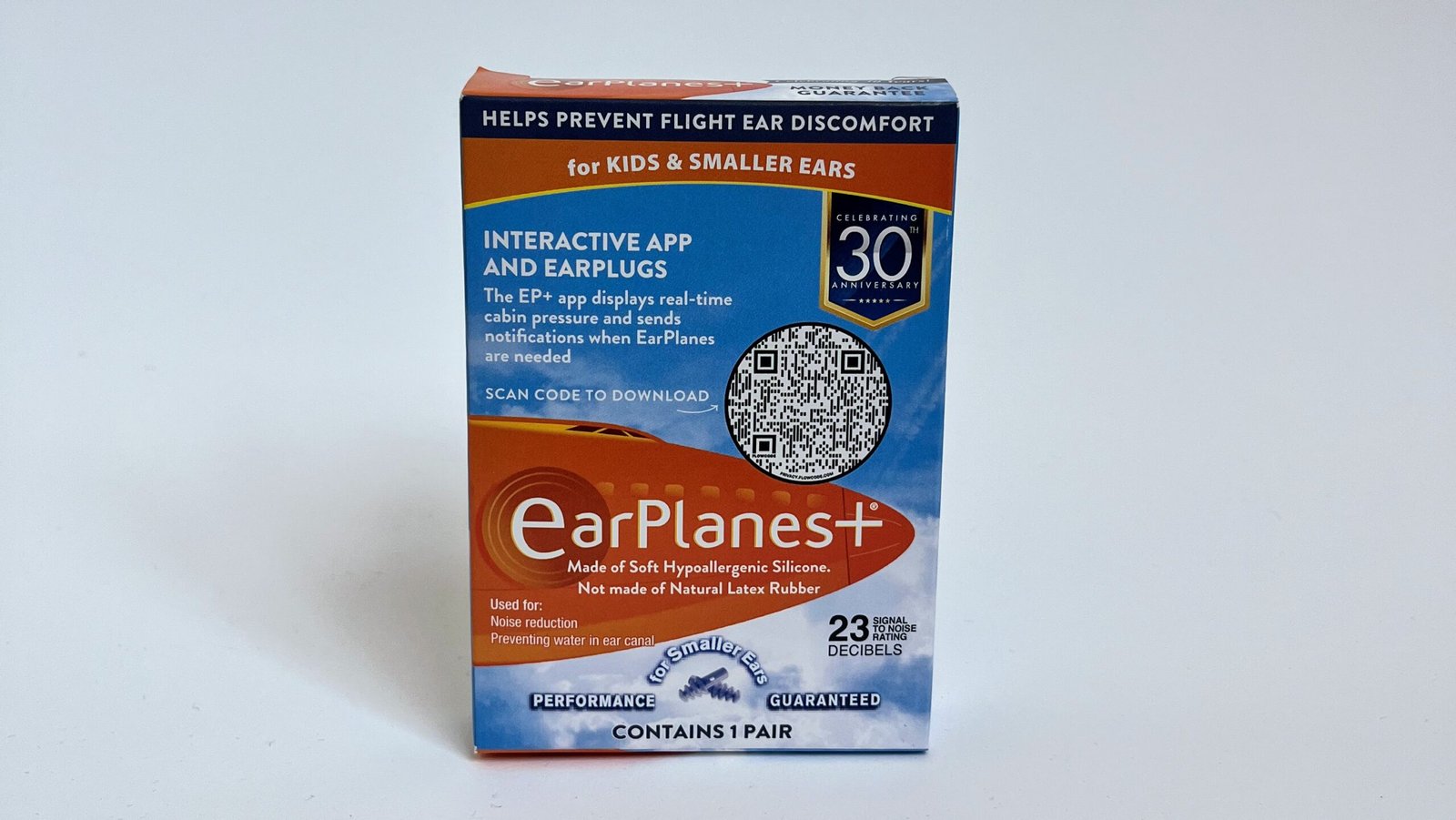
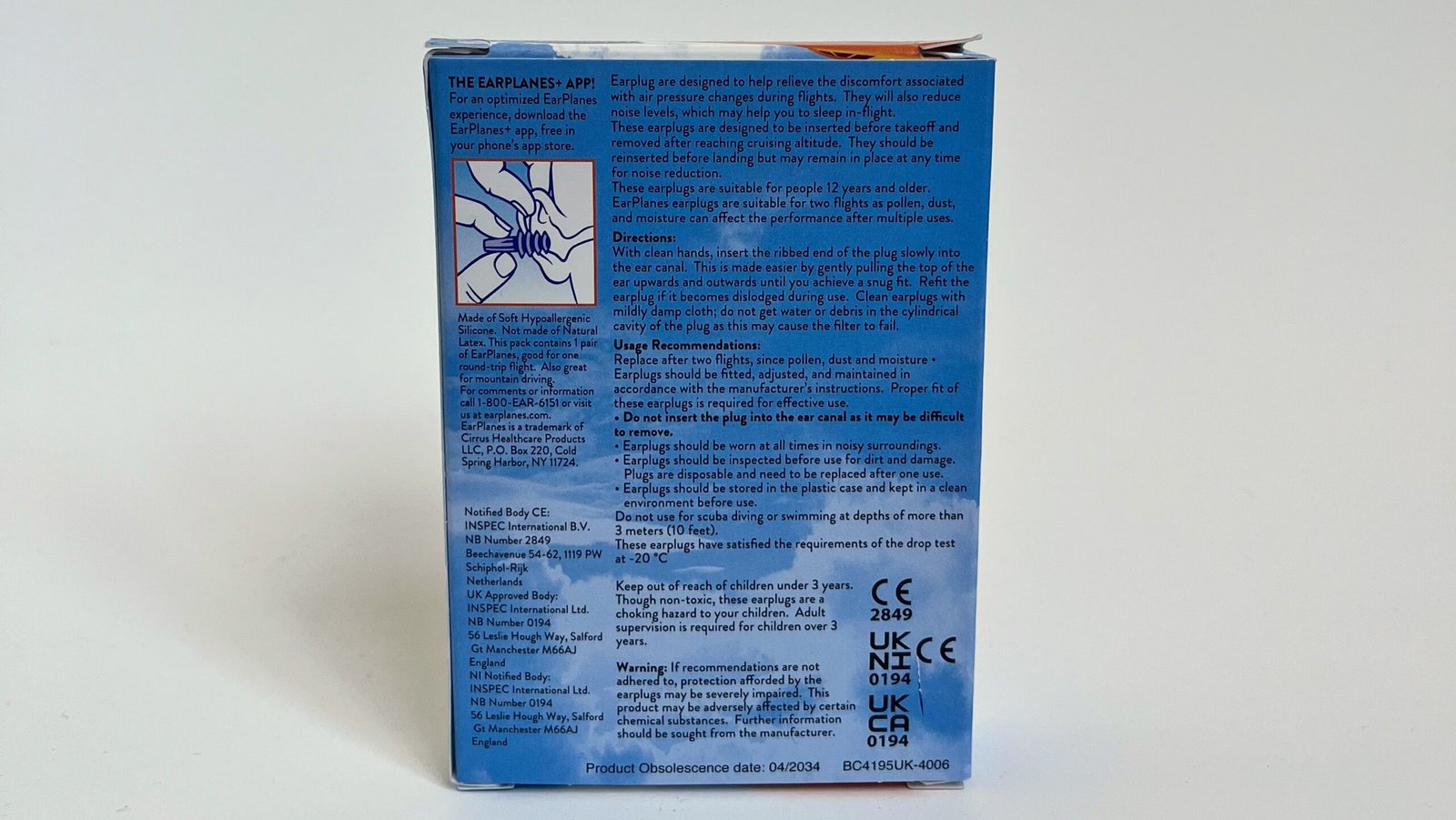
The packaging was the simplest in the investigation: a plain cardboard box and a round plastic travel case. It arrived unsealed, the case loose inside with no barrier, which raised enough of a hygiene concern to prompt a clean before first wear.
The plugs are pure matte blue silicone, dry and squishy with a slight squeak, neutral to look at, nothing to react to. No scent at all. The travel case, for its part, is excellent: compact enough for a coin pocket, hard-sided, snap-closed.
– Quiet Room Low occlusion is the one plus; insertion is hard and pressure builds
Insertion was hard: a level 4, dry and resistant, the multiple-flange design fighting the canal even with twisting, and no sense of a good seal. No tip-separation risk, since it’s one solid unit, but it had to go in too deep to attenuate anything, which was its own concern. Own voice was only about 20% altered, the lowest occlusion in the set, breathing faint, heartbeat absent. Pressure became uncomfortable by 15 minutes, a slight headache and jaw ache, and held there. Removal was clean and dry, no pop.
✗ Home Office The mechanical noise that matters barely moved
Very little benefit. The full spectrum came through at perhaps 10 to 20% attenuation: the kettle slightly less crisp at the very top, the extractor hum down about 10%, the washing machine softened by a tenth. The fridge and extractor hum stayed audible. Speech was full, only the highest frequencies trimmed. The tone test had implied Loop Engage-level reduction here, but in practice the bands that matter barely moved, closer to Flare Calmer Pro than to anything useful.
✗ Commute Engine and voices came through; the pressure popping was the main event
No real benefit in a moderately noisy place with competing sound at every register. Engine and road noise came through at near full volume, passenger voices fully clear, a phone’s audio unchanged, a PA announcement crisp and hardly muffled. Conversation was easy, with only slight own-voice alteration. The problem was the pressure: the popping sensation that built over a few minutes was more distracting than any of the noise the plugs were supposedly reducing.
✗ Supermarket Modestly softer, but not the tool for a spiky, sudden-sound environment
Modestly softer, not meaningfully more bearable. The PA stayed very clear and annoying, checkout beeps clear but semi-softened, the refrigeration hum down only about 10%, trolley impacts unattenuated. Background music dropped about a quarter. Other customers’ voices were softer but clearly heard. Speaking to a staff member needed no removal. Better than nothing, but not a product you’d choose for an environment of sudden sounds and high input across many frequencies.
✗ Open Plan Office Almost no reduction, and uncomfortable to wear for long
Very little difference for any sound or frequency. Keyboard noise came through nearly as normal, a neighbour’s phone call fully clear at barely reduced volume, the HVAC hardly touched, which raised the question of whether the plug was simply too small to seal. Desk-eating sounds were unimproved. A colleague speaking directly was clear. The lodged, full-insertion feeling grew unpleasant over an hour into a strong desire to remove them. Not a day-long office solution, and minimal occlusion when moving.
✗ Restaurant / Cafe Little difference in a loud room; Loop Engage does more
The stage that produced the verdict. Eating sounds barely improved, your own a little louder through occlusion; cutlery near normal volume, just slightly soft; background music a full experience; sudden sounds unchanged. The general hubbub softened a touch but far less than other plugs. A companion was fully intelligible. The honest summary is that they made little difference in this high-sensory environment, and Loop Engage is a more effective choice if you want a light filter while staying social.
Post-Removal Recovery
Immediately after removal: sounds at normal volume. No adjustment period needed. No residual pressure.
Emotional state: no calmer than before. The experience of wearing them was mildly uncomfortable; the experience of removing them was neutral. No heightened sensitivity on removal as observed with higher-attenuation products.
What the packaging says — what was found

What the packaging says — what was found

| The claim | Finding | Note |
|---|---|---|
| "Prevents ear pain by regulating cabin air pressure, slowing the change so the ear can adjust" Partial | – | This is the flight use, and no flight was tested. Assumed to work as designed until shown otherwise; this review takes no position on it. |
| "Reduces volume, lowering harsh airplane noise by up to 20dB" Partial | – | As a daily-noise figure it didn't materialise in any live environment, despite the tone test, which was the surprise of this lateral test. |
| "CeramX filter regulates air pressure via microscopic pores that release air slowly" Partial | – | The slow-release design is real and prevents a piston effect, but on the ground it did not prevent ear-canal pressure; in daily wear pressure built rather than equalised. A flight would be needed to judge it fully. |
| "Designed for smaller ear canals (children / small adults)" Partial | – | The small size fit a smaller canal but was not very comfortable, needing deep, resistant insertion. |
| "Reusable" Partial | – | Very reusable in appearance and stays clean, but the maker recommends disposal after two flights, roughly four daily wears, a shorter rated life than other silicone plugs. |
Who this suits — and who it doesn’t

- The lowest occlusion of any plug tested: own voice barely altered, no breathing amplification, no footstep thud
- Conversation possible throughout without removal, since it barely attenuates anything
- No piston effect on insertion or removal: the ceramic filter lets air move slowly through
- Stays clean and shows no degradation; a dry wipe is all it needs
- Inconspicuous blue silicone with the most compact travel case in the investigation
- Genuinely well-engineered for its actual purpose (flight pressure), which was not tested here
- Almost no noise attenuation in any daily environment, despite a promising tone test
- The ceramic filter is too slow and fine to block sustained ambient noise
- Pressure builds from 5 to 10 minutes, a popping sensation more distracting than the noise it was meant to reduce
- Dry, resistant insertion needing more force than any other silicone plug tested
- Requires deep seating for any effect, prompting repeated depth checks in a smaller canal
- Manufacturer recommends disposal after two flights, roughly four daily wears: a short life
- The flight / cabin-pressure claim could not be tested here, so it's neither confirmed nor denied
EarPlanes are built for one job: slowing the rapid cabin-pressure changes of a flight’s climb and descent, using a microporous ceramic filter that lets air equalise gradually. That flight job was not tested here. What this lateral test asked was whether they help with everyday noise, and across six daily environments the answer was almost nothing. The tone test had suggested otherwise, with figures at a couple of frequencies close to Loop Engage, but in real rooms the bus engine, the supermarket PA, and the office hubbub came through largely unchanged.
The explanation is in the mechanism. The ceramic filter is tuned to slow rapid pressure shifts, not to block steady ambient noise, and its pores are too slow and too fine for sustained sound to be attenuated the way the bench numbers implied. Blow through these and almost nothing passes, where the Alpine PartyPlug lets air move freely; that gap in porosity is the whole difference in real-world performance.
So the verdict is flagged, as tested by one reviewer on the ground and outside the product’s intended use. There is one honest upside: the lowest occlusion of any plug in the investigation, so own voice and breathing are barely affected, which is the only reason to consider them daily, and a narrow one. For a flight plug that does attenuate daily noise, see the Alpine PartyPlug, which shares the air-permeable idea but executes it far better. For all ten products, see Earplugs for Sensory-Sensitive Adults.