
No sponsorship, no freebies. Links here earn a small commission at no extra cost to you, which keeps the investigations independent. More info
Best earplugs for misophonia: what the data says
Ten earplugs tested across seven environments. Some block the sounds that matter, some make things worse, and the difference is which frequencies each one actually attenuates.
Tested by an autistic, sound-sensitive reviewer with smaller than average ear canals. Every product bought, none gifted. Not medical treatment advice.
My father would pull up a chair next to me at breakfast. I knew what came next. The slurping, the sucking of cereal. I wonder if he ever noticed how often I left early, a half-finished bowl behind me. Cereal and soup remain risky business to this day.
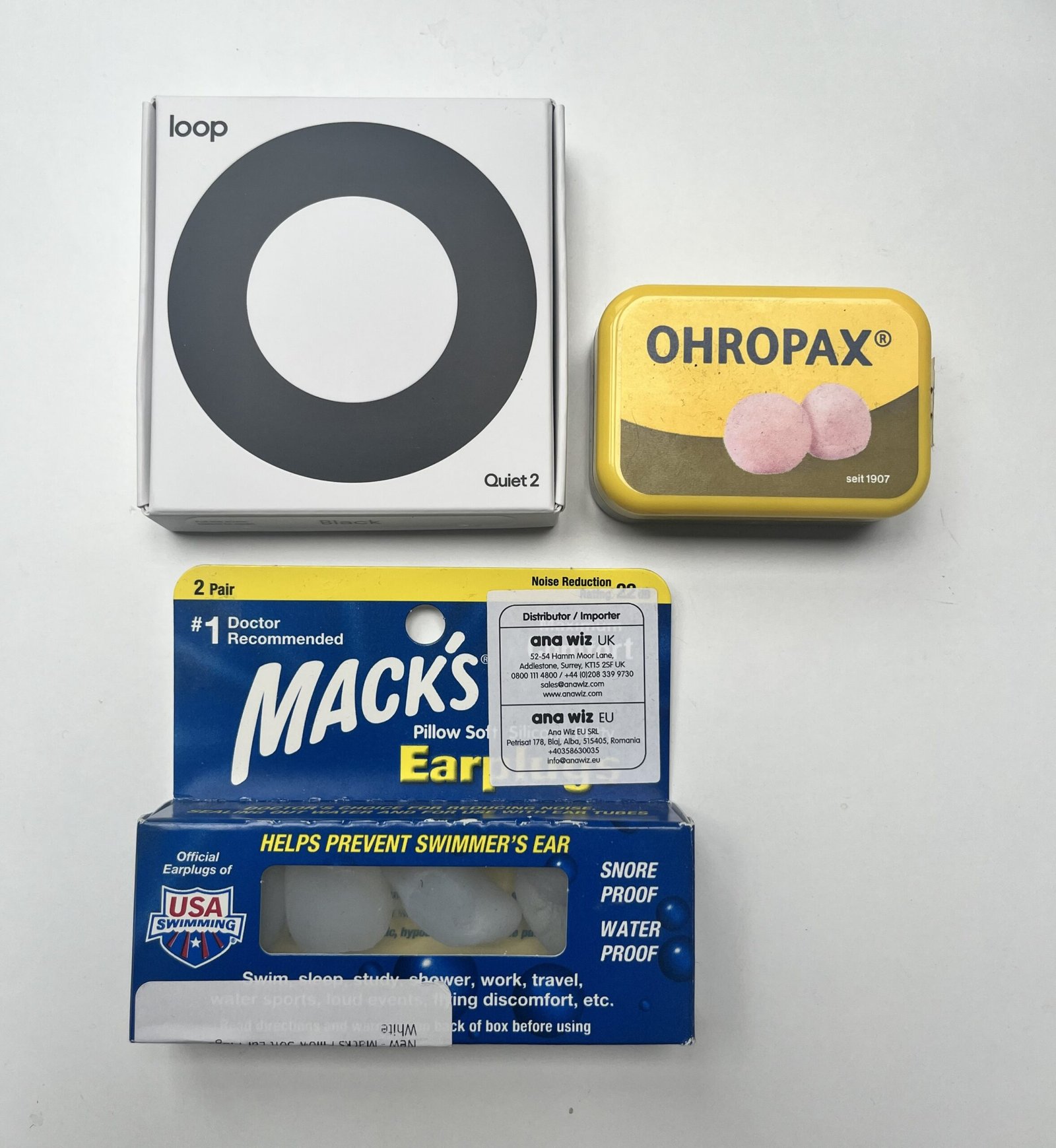
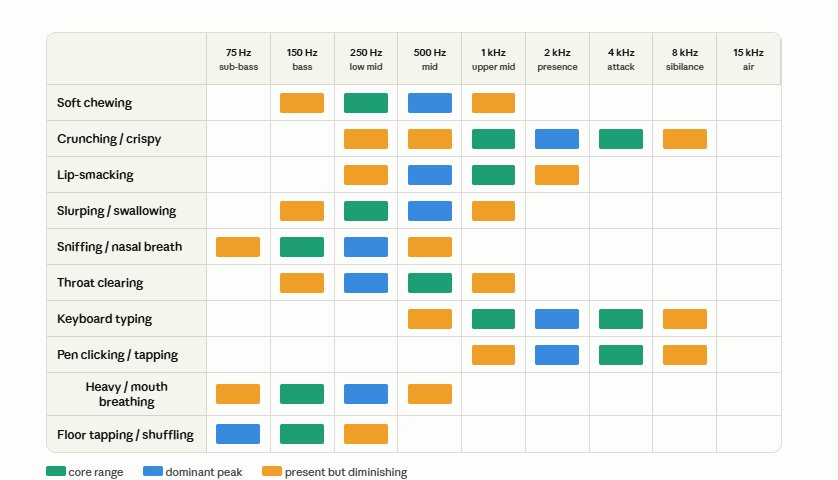
Ten earplugs by 8 brands, nine frequencies from 75 Hz to 15 kHz used to measure exclusion, then the same products taken into seven real world environments. Every trigger is mapped to the frequency band it mainly occupies, so the question stops being how much an earplug blocks and becomes whether it blocks the part that matters to you.
I’m autistic and sound-sensitive, and misophonia has shaped my meals since childhood. Smaller than average ear canals, which changes how most plugs seat, and I wear glasses. A reviewer who isn’t troubled by slurping can’t tell you whether a plug removes it. They were never listening for it.
BOST takes no sponsorship and runs no ads. If you buy through the links here, a small commission comes back to the site at no extra cost to you. That’s what keeps these investigations independent.
Why most earplug advice for misophonia is wrong
If you’ve looked for earplug advice for misophonia, you’ve probably found the same thing I did. A list of products ranked by NRR rating, claiming that higher number = better product. That logic fails because misophonia isn’t primarily a volume problem. It’s our brains performing pattern recognition: a mental salience network flagging a specific sound and firing a threat response (again and again). We do this whether we hear the sound loud or quiet.
Most earplugs are good at reducing noises at specific frequencies. Whether that helps you with misophonia depends entirely on which frequencies each trigger occupies and if this is now being filtered out. That’s our approach, roughly and it is a question no standard review answers.
One further finding complicates simple volume reduction. Researchers have found that spectral modification, changing the character of a sound, reduces misophonic reactions more than volume reduction alone. i.e. the brain recognises what a sound is, not only how loud it is, and a scrambled version of chewing triggers less distress than recognisable chewing at the same volume. Which is why an earplug that halves the volume of chewing may not halve the distress, and why near-total suppression in the right band matters more than a good average across all of them.
What to buy
Two products came out of this investigation with recommendations attached. Each of these two do different things. One is for when you need the trigger gone, dead gone. The other is for when you need the trigger reduced but still need to hear other noises – like dinner table conversation. Unfortunately, nothing tested to date does both (and any product claiming to should be treated with suspicion).
Mack’s Pillow Soft silicone putty
Blocking within a whisker of foam earplugs at the frequencies that carry mouth sounds: 20% through at 250 Hz (chewing), 10% at 125 Hz (breathing). The putty seal improves as the it warms to body temperature and it caps the canal entrance rather than expanding inside it, so there’s no deep insertion and no slow outward creep unlike foam earplugs. It comes in a hard case and can be reused rather, which makes it considerably more hygienic and typically more clean looking than a porous foam plug which makes it a better mealtime companion. If you carry one thing, carry this.
Read case file →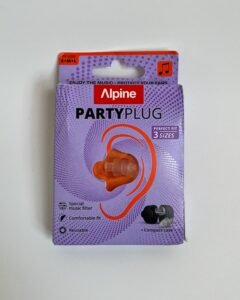
Alpine PartyPlug
The unexpected finding of the investigation. A concert earplug (tested laterally) that outperformed Loop Engage on both chewing attenuation and conversation viability. Speech stayed intelligible, chewing came down by a useful amount, and it’s the only product tested that manages both at once. If you need to sit at a table and take part rather than withdraw, this is the compromise that works best.
Read case file →Pure blocking strength belongs to 3M 1100 foam. It only let 3% of many trigger noises through and was the only product to eliminate chewing sounds outright in testing. It’s the strongest noise attenuator tested and it costs very little. It’s also disposable, hygienically awkward to reuse, which is why Mack’s takes the recommendation.
Eating: solo, in a group (but when you’re not eating too)
For many these are the worst trigger sounds and the most reported. Chewing, slurping and lip-smacking have low frequencies mainly between 125 and 500 Hz. Tragically, this overlaps with voice frequencies of anyone you’re trying to listen to which means you can’t cut mouth noises but hear speech. That overlap is the whole problem.
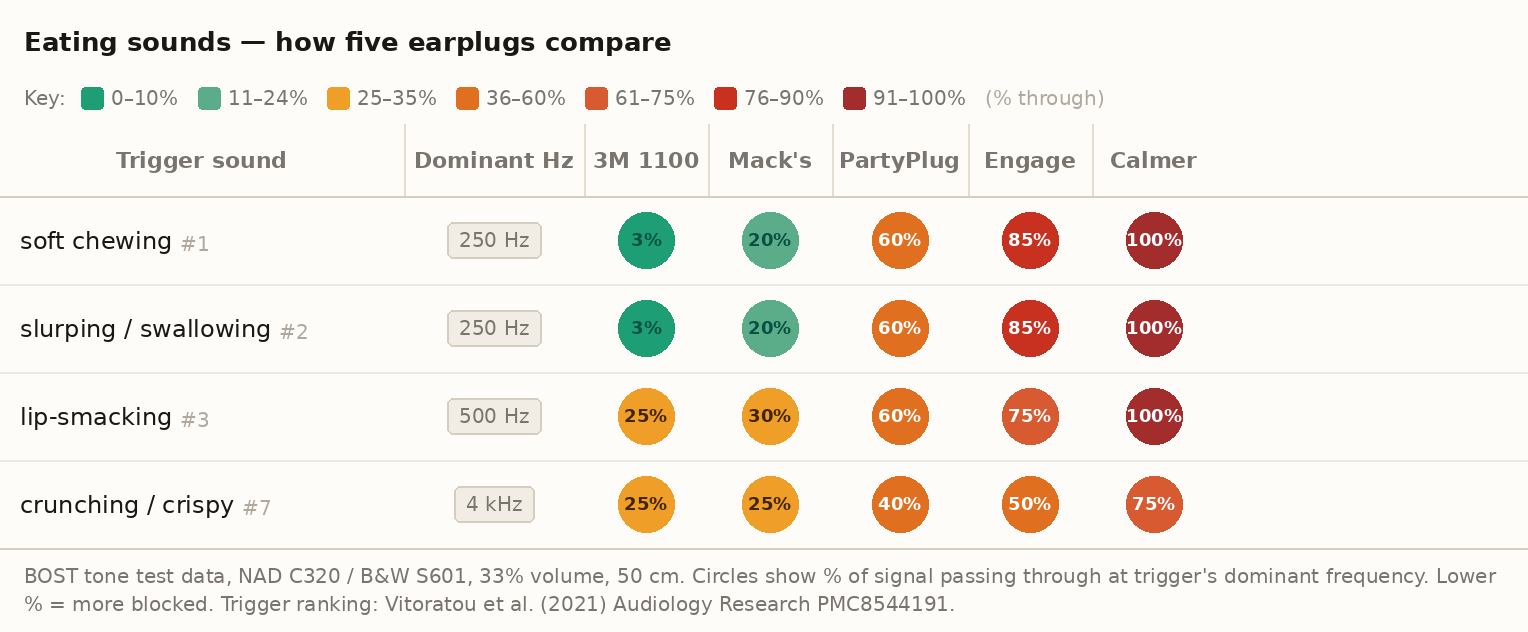
There is a tradeoff impossible to get around: if you want to hear the conversation, you will hear the chewing, because they occupy the same frequencies. No passive earplug can separate them. As seen in the middle-scores above, PartyPlug is the best available compromise but it is still a compromise. The investigator found that in a noisy food environment, these cut noise overall including a certain amount of gustatory input. Of course there is potentially the risk with these semi-filters (same with Loop Engage) that once you reduce the background din, the mouth frequencies actually come through clearer. It’s risky business.
If you don’t need to hear anyone, a silicone putty, wax, or foam earplug will block everything evenly, removing the greatest proportion of mouth noises. For a solo meal in a dingy diner, this might be exactly the case where that’s the right solution.
If café noise as a whole is the problem rather than one specific trigger, the earplugs for sensory overload guide ranks products for that room on general load, not by trigger frequency.
Office: open plan, desk eating, keyboard noise
Office triggers sit higher and sharper, which changes which products work. Keyboard typing centers around 2 kHz, pen clicking around 4 kHz, and both are more tractable than mouth sounds for most plugs. Floor tapping is the exception: in the 75 Hz range it travels partly as structure-borne vibration through the floor and into your body, which no air-conducted ear plug can really help with.
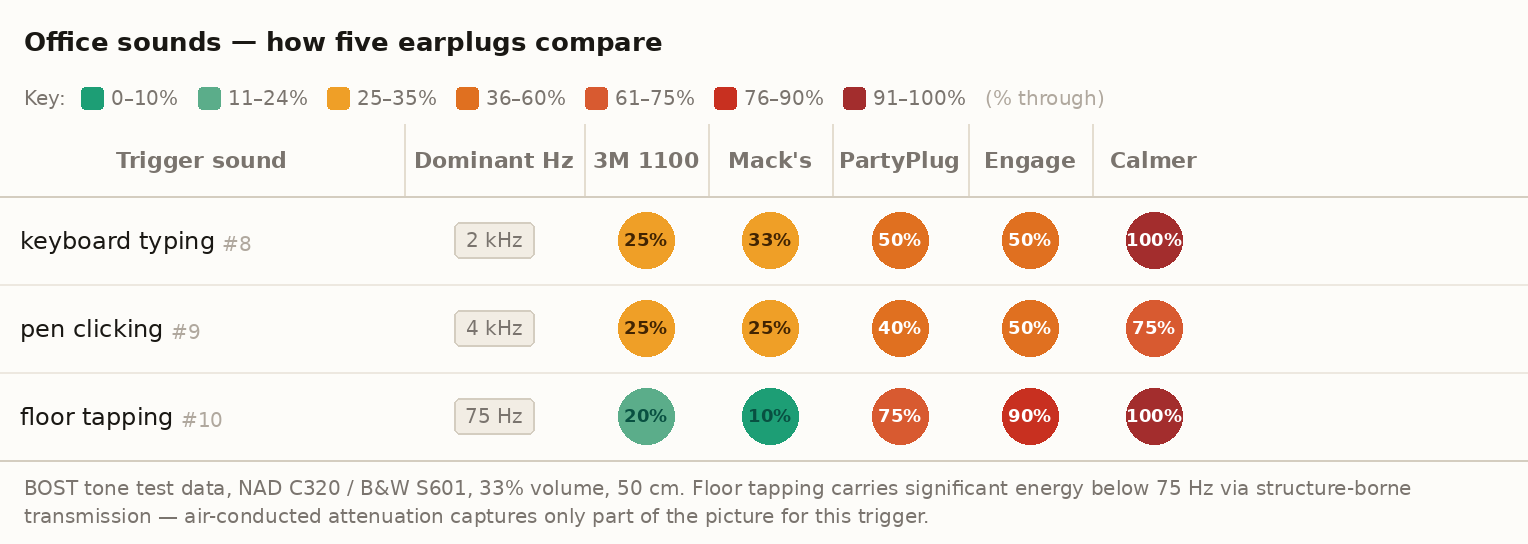
The practical difficulty at a desk isn’t acoustic, it’s social. Full-blocking plugs work and make you unreachable, which is fine for focused work but potentially unworkable if colleagues expect to swing by ‘for a quick question’. This is the environment where a headphone often serves better than a plug, and the headphone findings for misophonia cover that case in detail.
For open-plan noise generally, rather than specific triggers, earplugs for sensory overload ranks products room by room, including this one.
Body sounds: sniffing, breathing, throat clearing
This category is often around one specific person at close range. Sniffing and heavy breathing frequencies are 125 Hz, throat clearing nearer 500 Hz, and these low frequencies are what earplugs are good at due to their physical seal which handles low frequencies well. Mack’s blocked 90% of 125 Hz, and 3M foam plugs did the same.
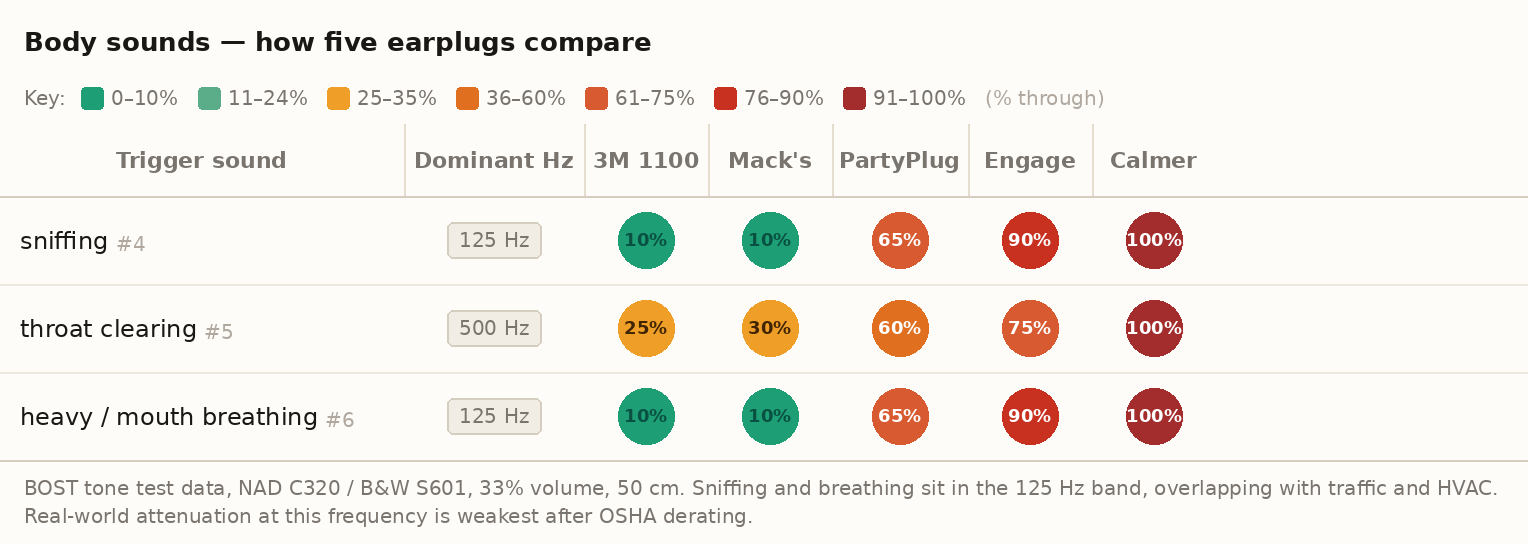
Loop Engage and Flare Calmer are the products to avoid for this trigger group. In testing, 90 to 100% of body-sound frequencies passed straight through both. Neither offers useful attenuation in this context, whatever the marketing suggests.
Are Loop earplugs any good for misophonia?
Loop dominates this conversation. The products are well designed, they look like jewellery rather than medical equipment, and they’ve become the default recommendation across autism and sensory communities. Both models went through the same tone tests as everything else here, and for mouth and body triggers specifically, neither impressed.
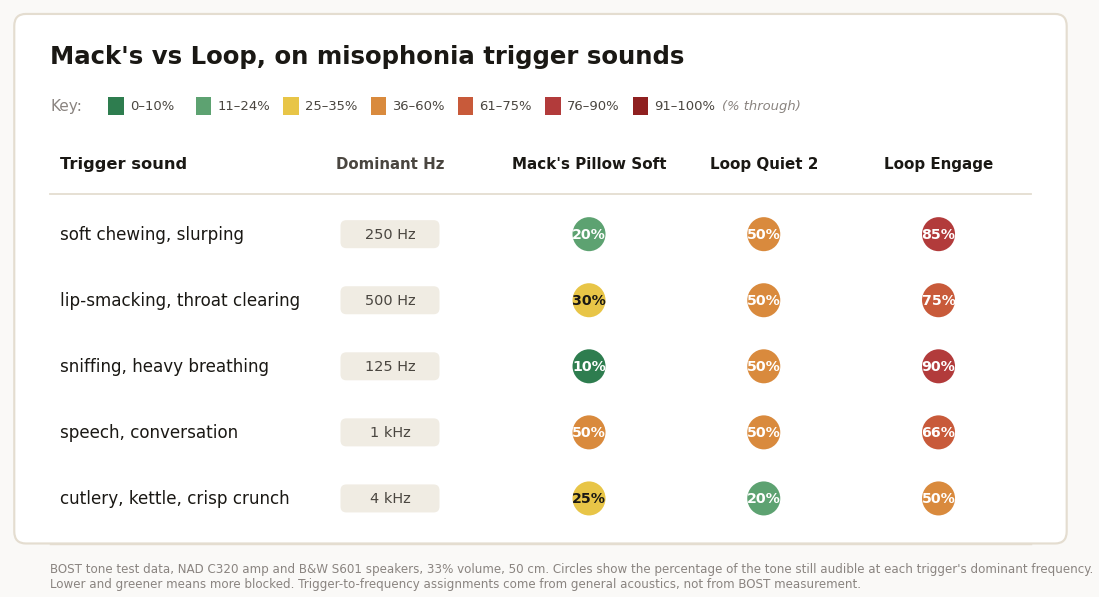
Loop Quiet 2 is the stronger of the two. It let roughly half the signal through across the trigger bands, against foam earplug’s 97% to 75% blocking, and it seals decently for a flanged silicone. For overall volume reduction it does that generalist job adequately. For a specific chewing sound, half of it still coming through is enough to still irritate you. It also occludes your own noises more than putty or wax, so your own chewing sounds louder over a long meal. Horrid.
Loop Engage is the one that really was problematic, and the reason is design rather than defect. Engage exists to keep conversation audible, so it deliberately passes the mid frequencies through: Chewing, slurping and throat clearing sit in and around that same range. The product does exactly what it was engineered to do, and what it was engineered to do means that it lets your triggers through. That isn’t the impression its marketing leaves, and it’s the most common mismatch seen recommended in online forums. If open-fit is what you need, PartyPlug did the same job better.
These are findings from one reviewer’s test rig and ears rather than established fact, and Loop’s own position differs.
What earplugs can’t fix
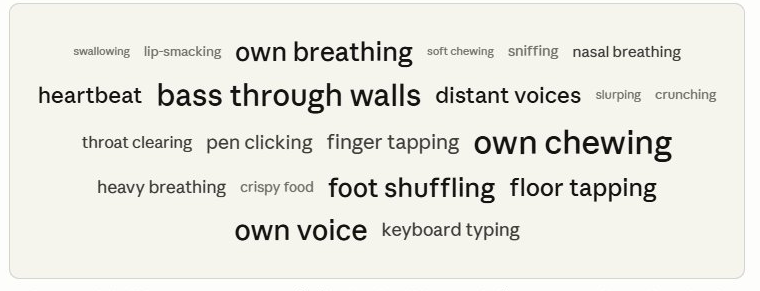
The trigger may still be recognisable. A plug that attenuates by 75% can still leave enough pattern information for the brain to identify the sound and fire the response. The 3M 1100’s near-total suppression at 250 Hz is the closest thing tested to rendering soft chewing genuinely unrecognisable, which is likely why it was the only product to eliminate chewing outright rather than merely quieten it.
The occlusion trade-off. Seal the canal and your own chewing, breathing and voice come back louder through bone conduction. It’s a real cost and it lands hardest on anyone triggered by their own sounds. Entrance-seal wax and putty produce less of it than deep-insertion foam, and the flanged silicones, Loop Quiet 2 and Alpine Silence, occlude most of all. Over a ninety-minute dinner that difference matters. The mechanism is covered in the occlusion effect explainer.
Overuse makes sensitivity worse. This point has clinical consensus behind it. Starving the auditory system of sound increases sensitivity to soft sounds, in exactly the frequency range where triggers sit. These are situational tools for bounded periods, not daily armour.
Sometimes a headphone is the better tool. Plugs block; they can’t replace a sound with another one. Where masking is what you need, or where you have to stay reachable at a desk, the answer is a different device. Start with how to deal with misophonia if you’re still choosing between categories.
How this was tested
Every product in this investigation got a minimum of ten hours. First on the bench: nine test tones from 75 Hz to 15 kHz played through a NAD C320 amp and B&W S601 speakers at 33% volume, 50 cm from the ear, with the percentage of each tone still audible recorded by ear. Then eardrum pressure timed at 15, 30, 60 and 90 minutes, and an occlusion test covering own voice, own chewing and own footsteps.
Then the same plugs went out into the world, because a product that behaves on a bench can fail in a café. The real-world circuit runs across seven environments including home, an open plan office, a café, a supermarket and a bus. Findings from those environments are first person and reported as such, because how a plug feels at minute forty is not something a meter records. The lab results are a different matter: those are replicable, the equipment and settings are published, and anyone with the same amp and speakers can run them again and check my work.
The full earplug methodology is published, including the parts that didn’t work. Every product receives one of three verdicts, Cleared, Caution or Flagged. No stars, no scores, no rankings.
Common questions about earplugs for misophonia
Which earplugs block chewing sounds best?
3M 1100 foam blocked chewing most completely in testing, letting only 3% of the 250 Hz band through, and it was the only product to eliminate chewing sounds outright rather than reduce them. Mack’s Pillow Soft came close at 20% through, with better hygiene and reusability, which is why it takes the overall recommendation here.
Do Loop earplugs help with misophonia?
Less than their popularity suggests, on the evidence from this investigation. Loop Quiet 2 let around half the trigger signal through, and Loop Engage passed considerably more, which follows from its design intent of keeping speech audible. Those are findings from one reviewer’s rig and ears rather than established fact, and Loop’s own position differs. For general volume reduction and sleep, both did reasonable work.
Can I wear earplugs all day for misophonia relief?
Better not to. Prolonged reduction of everyday sound is associated with increased sensitivity over time, which risks worsening the underlying problem. The Misophonia Institute frames sound-based tools as appropriate for specific, limited situations rather than daily use. Comfort points the same way: several plugs tested became genuinely uncomfortable between 30 and 90 minutes.
Why do my own chewing and breathing get louder with earplugs in?
That’s the occlusion effect. Sealing the canal traps sound conducted through your skull, so your own body gets louder as the outside world gets quieter. It’s strongest with deep-insertion foam and flanged silicones, and mildest with entrance-seal wax and putty. If your own sounds trigger you, that difference should drive the purchase.
The mechanism, and which products produce least of it, is in the occlusion effect explainer.
Are earplugs or headphones better for misophonia?
Earplugs block considerably more, headphones cover more situations and can mask rather than merely reduce. If you want the sound gone and don’t need to hear anything else, take the plug. If you need to stay reachable, or you want a neutral sound in place of the trigger, take the headphone. The full comparison is in how to deal with misophonia.
Is there a treatment for misophonia?
There’s no cure, and no earplug is a treatment. Clinical management usually centres on therapeutic approaches such as CBT, sometimes alongside sound-based tools, and for most people finding what reduces their triggers is trial and error. Comparative data helps by narrowing the trials, which is what this page is for.
For clinical guidance rather than product data, the Misophonia Institute and Harvard Health are better starting points, and a clinician who knows your history is better than either. BOST exists to help you make better informed product decisions by providing data, and it is no substitute for meeting a professional face to face.