
No sponsorship, no freebies. Links here earn a small commission at no extra cost to you, which keeps the investigations independent. More info
Bose QuietComfort Ultra vs QuietComfort: Worth the Upgrade?
A in-depth comparison review of Bose's two most popular Noise Cancelling Headphones to see what the newest version does for sensory sensitive and autistic users
Independent testing (both units purchased, not gifted)
It is deeply ingrained in consumers that newer is always better and that more expensive is always going to get you something more. The thing with headphones is that that ‘more’ is hidden inside a plastic shell, and you’re relying on the dark arts of noise cancelling software to deliver it. So what are you really getting from Bose’s Ultra 2nd Generation, and does it make the world any more bearable? Autistic and noise sensitive people often rely on these as a means of survival in a world which is just too loud and too unpredictable. But the core question here at BOST is whether Bose’s engineers had even thought to improve the things that matter. What does the cancellation do to your eardrums after an hour? Does the thing produce a high pitched squeal in a silent room? Nothing in either product’s marketing suggests any of that was tested, so the investigation tested it.
Bose Ultra or the standard QuietComfort?
Buy the QuietComfort. It is the lowest-pressure, quietest self-noise headphone in this investigation.This autistic reviewer concludes: buy the standard QuietComfort. Switch the electronics off and it holds the low and mid frequencies about as well as the flagship, giving up only a little at the top. Switch them on and it blocked more recorded music and more recorded speech than any of the four headphones tested. It also produced the lowest eardrum pressure recorded anywhere in this investigation, one of the gentlest clamp force on a large head, and the faintest hiss of the batch. Lightest of the four, too.
Buy the Ultra if your problem is other people’s mouths, or if the rooms defeating you are cafés and supermarkets. Cancellation alone, it’s clearly better on chewing and lip smacking, and in genuinely loud public spaces it cuts more away. Add a masking sound and it masks slightly more efficiently, so you can run your pink noise a little quieter. It carries the site’s lowest verdict, Flagged, because of what happens on a bus.
NEVER SPONSORED. NEVER GIFTED. Every product tested on this site is bought at retail with my own money. Links are affiliate links and BOST may earn a commission at no extra cost to you, which has no bearing on any verdict. How this site makes money · How ANC headphones are tested
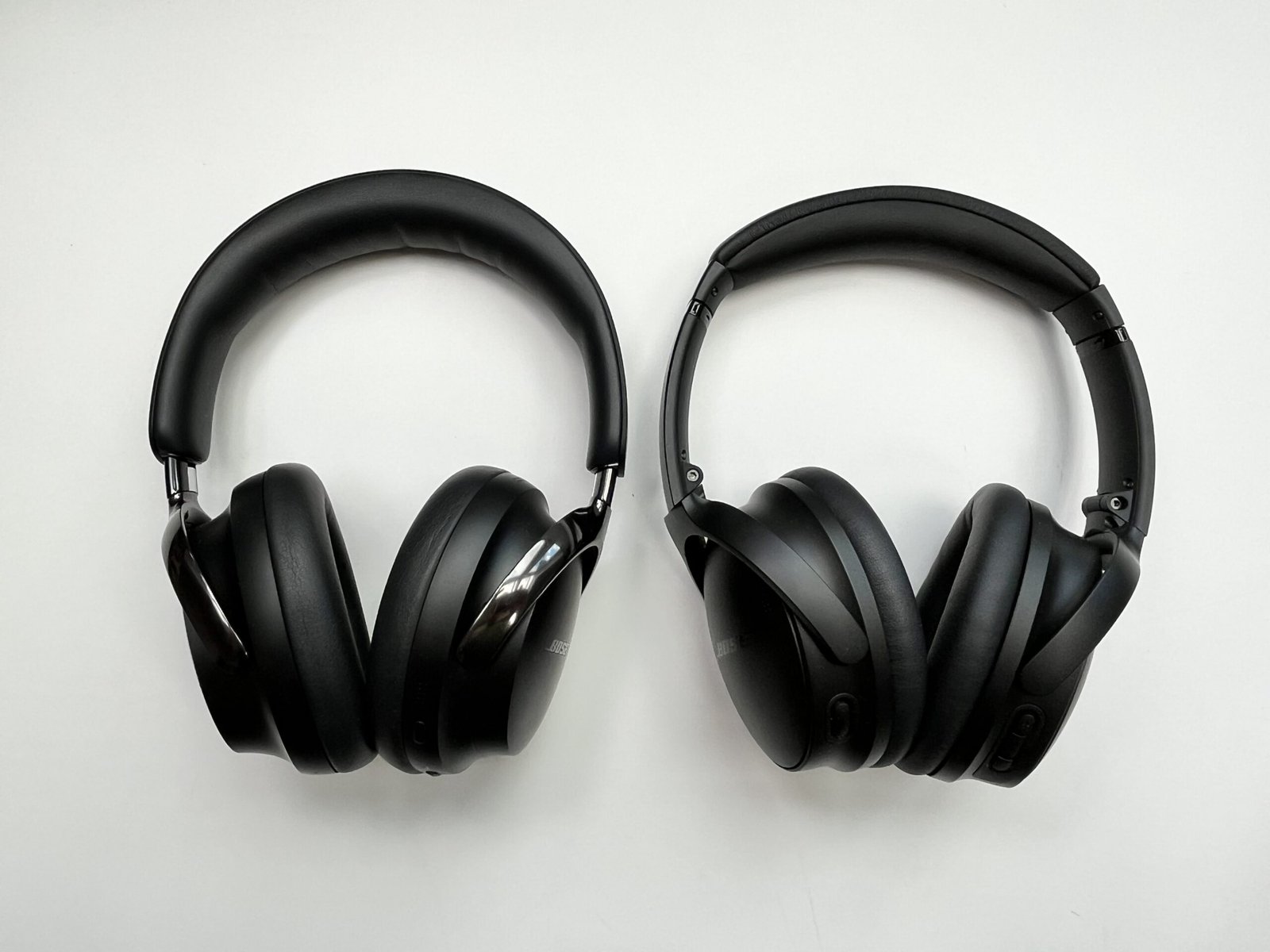
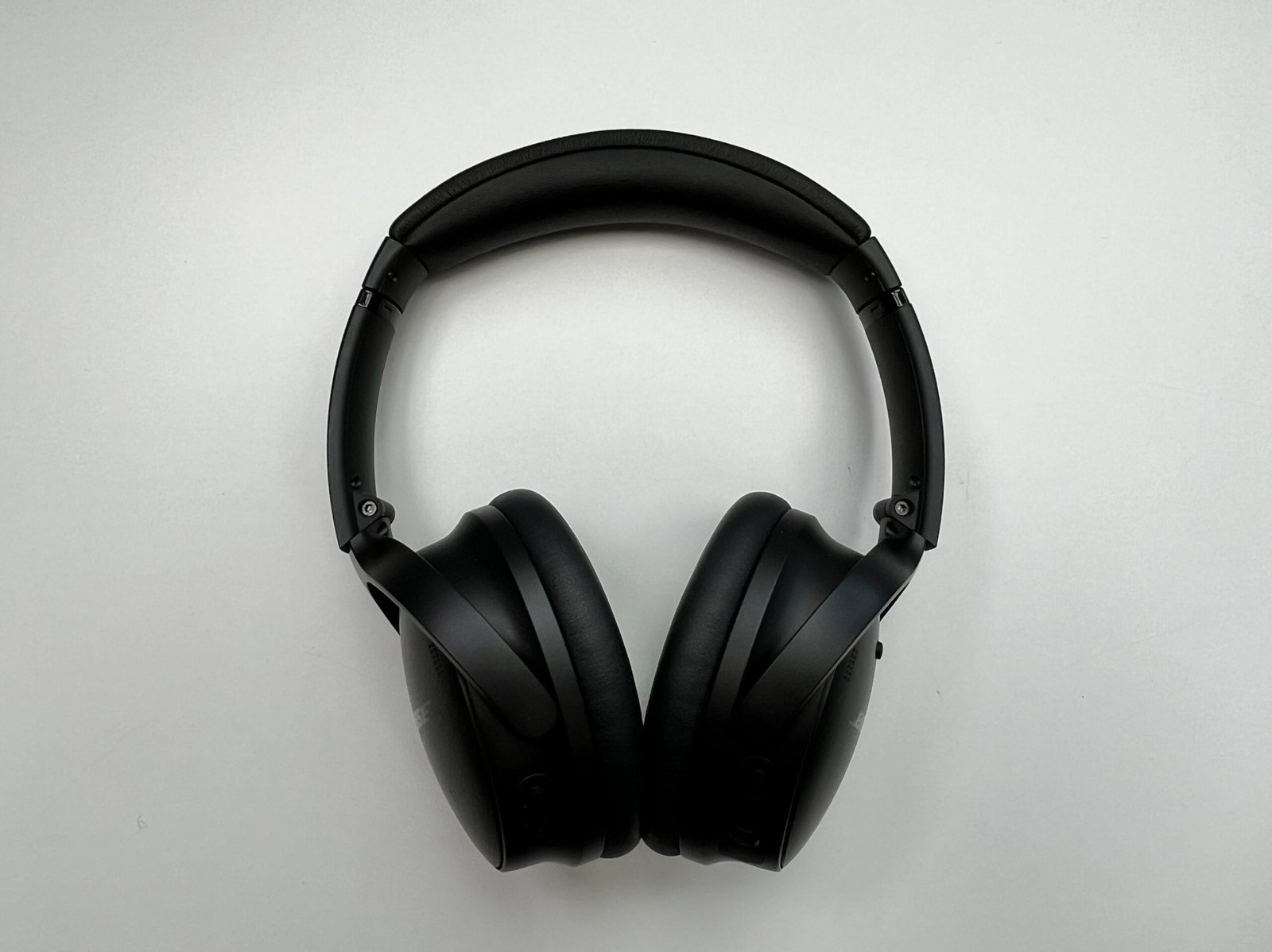
The two units, side by side
Both were bought at retail, worn by the same head, and run through the same protocol in the same six rooms across June and July. Same tests, same balloons. Glasses on throughout, because that’s how they get worn.
Bose QC Ultra 2nd Gen
Quiet, Aware, Immersive, Wind Block
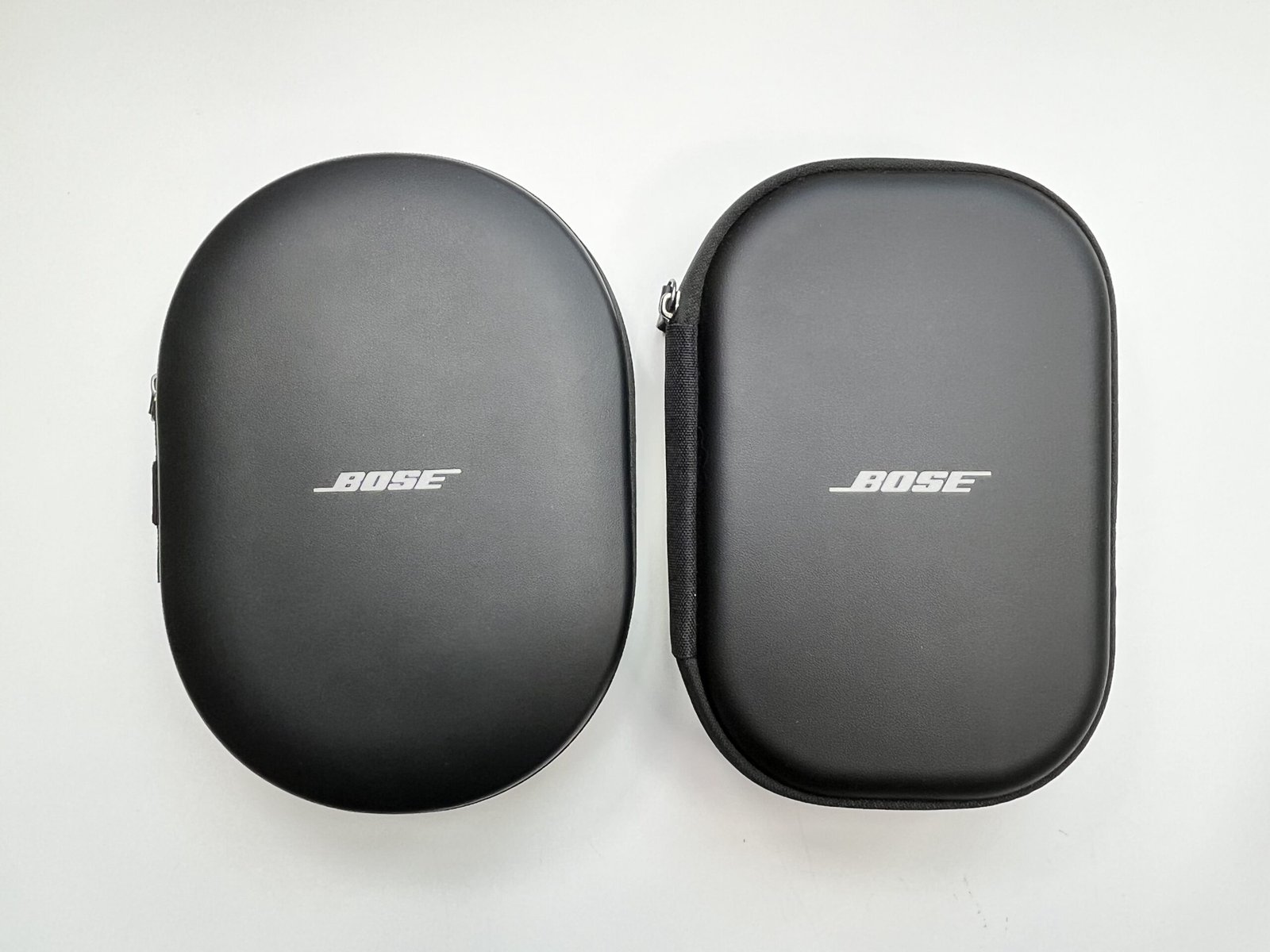
Polished metal, plush pads, and the nicest case in the batch. Very pleasing to handle, which is worth naming honestly and then setting aside, because once they’re on your head you can’t see any of it. No chemical smell at all on opening, the only unit tested that managed that. Heavier on any head, and it slips when you tilt.
Bose QuietComfort
Quiet, Aware, Wind Block
Cased plastic where the Ultra has metal, and it doesn’t matter. Lightest of the four and one of the gentlest clamp force on a large head of anything tested to date. Battery is decent without leading the batch. Faint chemical smell on arrival that had gone within a week. This is the pair that stays pleasant across a long wear.
Head to head, measured
Green cells mark the stronger result on that row. “Inaudible up to” means the signal had to be played at that level before it could be heard through the cancellation, so higher is better. Prices move constantly and are deliberately left out of this table; check current figures at the links.
Where the money goes, and where it does not
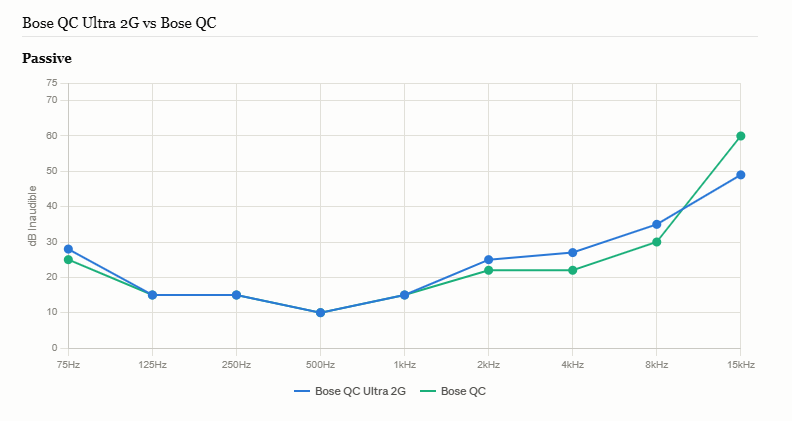
Nine tones, three conditions, both units. Method: NAD C320 amplifier, B&W S601 speakers, 33% volume, 50 cm. Every chart reads the same way: taller means the signal had to be played louder before it could be heard, so taller is better. Tap any chart to enlarge it.
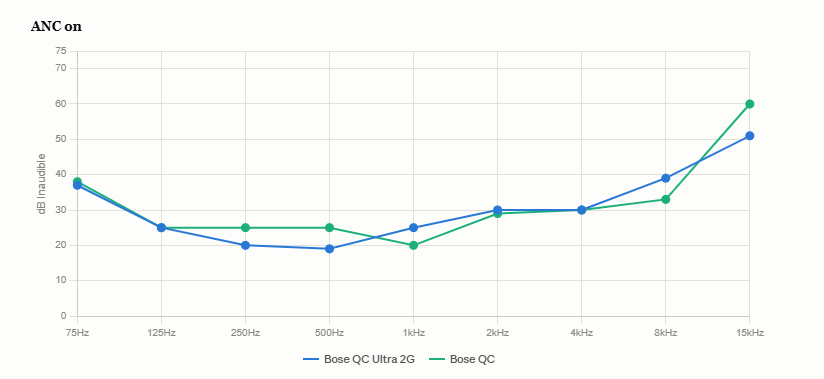
Start with the electronics off, in passive state, because that’s where the physical engineering shows. The older pair handled the low and mid frequencies about as well as the newer model and gave up only a little at the upper end. Physical seal quality and clamp force usually predict the quality of noise cancelling. Here they didn’t, which came as a real surprise.
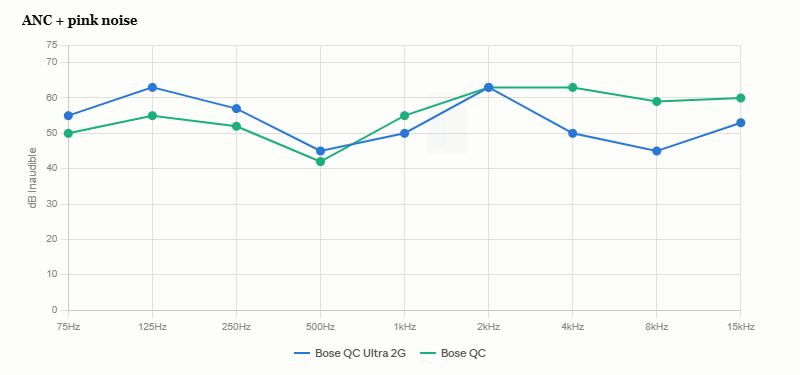
Then the music and speech clips ran, and the older pair won both.
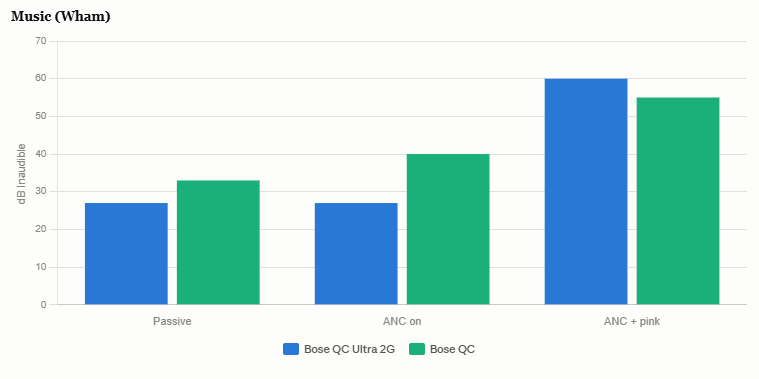
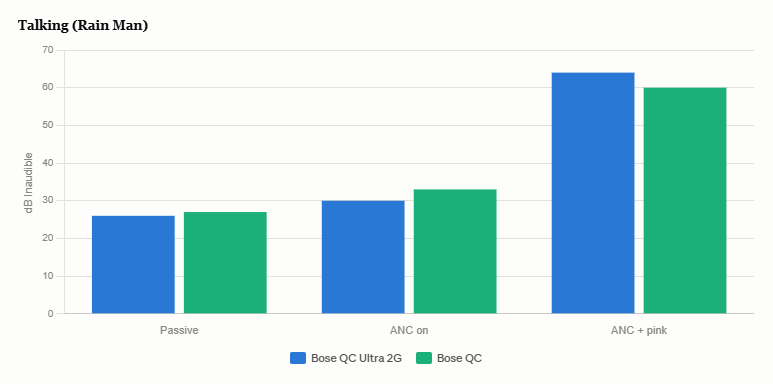
Softer clamp, lower ear pressure, and more of the music gone. Those three normally trade against each other. In this pair they arrived together, and they arrived on the cheaper one.
Add a masking sound and the picture evens out, with a small advantage back to the flagship. Both units handle pink noise well. The Ultra just needs slightly less of it, which means a quieter mask doing the same job. If you already run something in the background all day, that’s the one place the premium buys you something you’ll notice.
The pressure curve: what ninety minutes costs
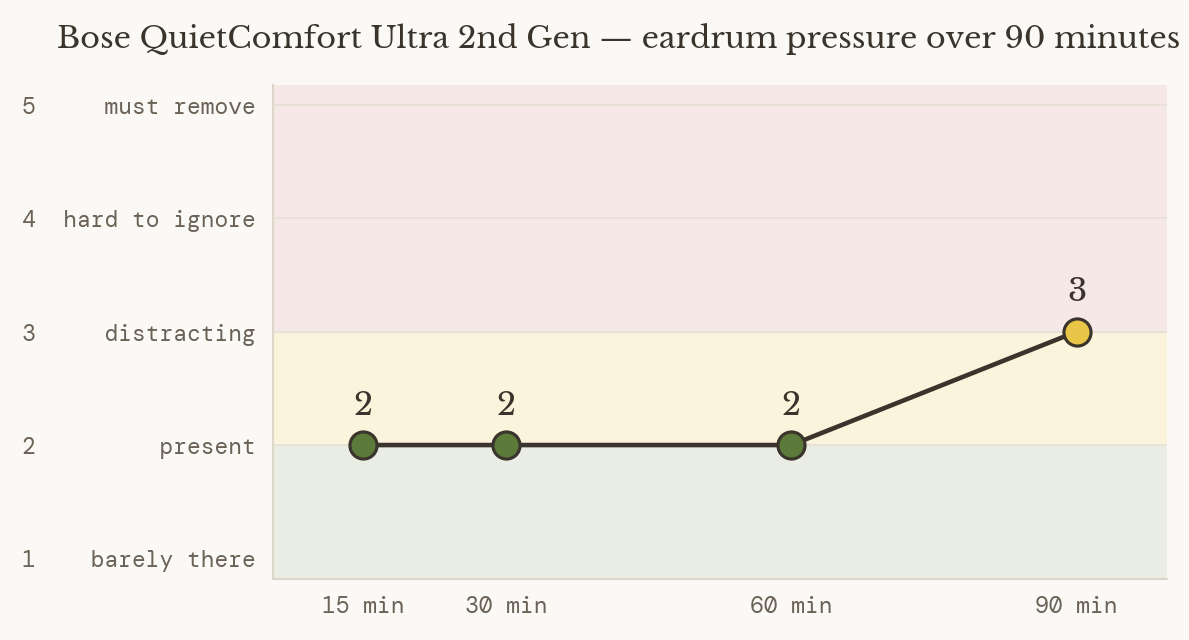
Both were worn for ninety minutes in the same quiet room, with a score recorded every fifteen minutes on a one to five scale.
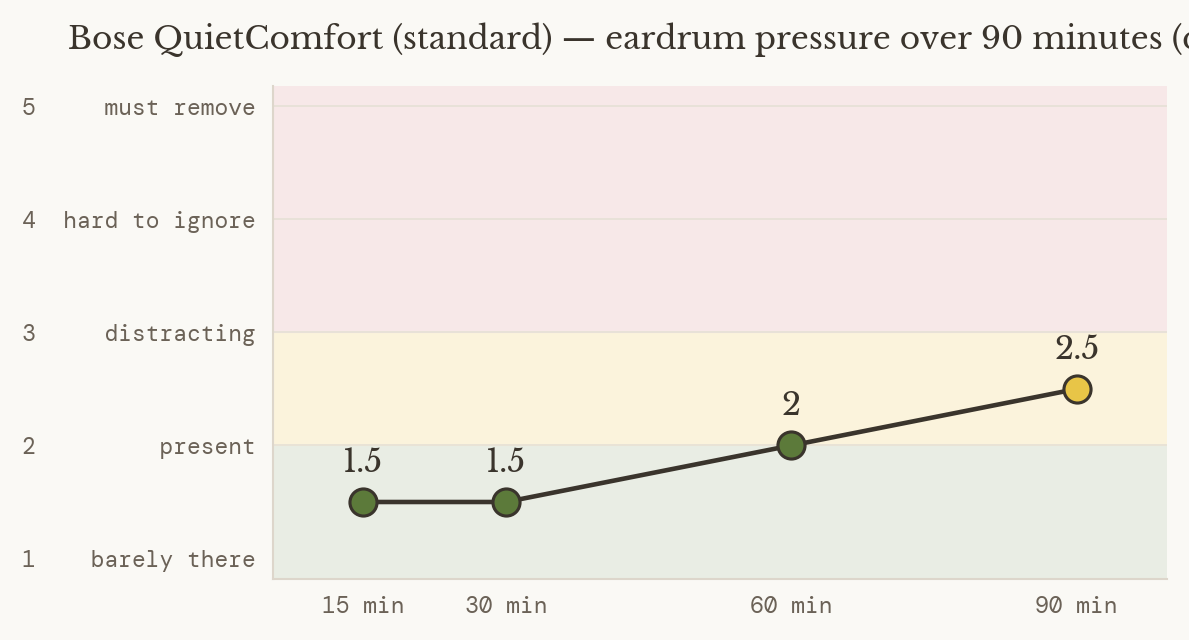
Standard QuietComfort held at a barely-there 1.5 through the first half hour, reached 2 at the hour, and finished at 2.5. Lowest of the batch, bar none. The Ultra sat at a mild 2 for the first hour, which is genuinely good, rose to 3 just past sixty minutes, then eased back by ninety. Confirmed over multiple sittings.
Quiet-room curves are the easy case, so the same comparison was run using a 75 dB generated background floor, which is where ANC works hardest and where pressure usually spikes. Same result. The QuietComfort came in lowest. When tested in real world sessions in genuinely noisy places there was the same result.
If you’ve ever searched whether noise cancelling headphones hurt your ears, this is the test that matters. Pressure is a major issue for autistic users. Not noise attenuation figures, not battery life, not the finish on the headband.
If ear pressure is your sensitivity, look to the earlier model, the QC.
Clamp force: why headphones give you a headache
Search for headphones and jaw pain and you’ll find thousands of people describing the same thing. An ache along the jaw hinge after an hour. A band of pressure above the ears that turns into a headache after a short use period. Tenderness at the temples. None of it is imagined, and almost none of it is measured, because manufacturers publish weight and never publish squeeze.
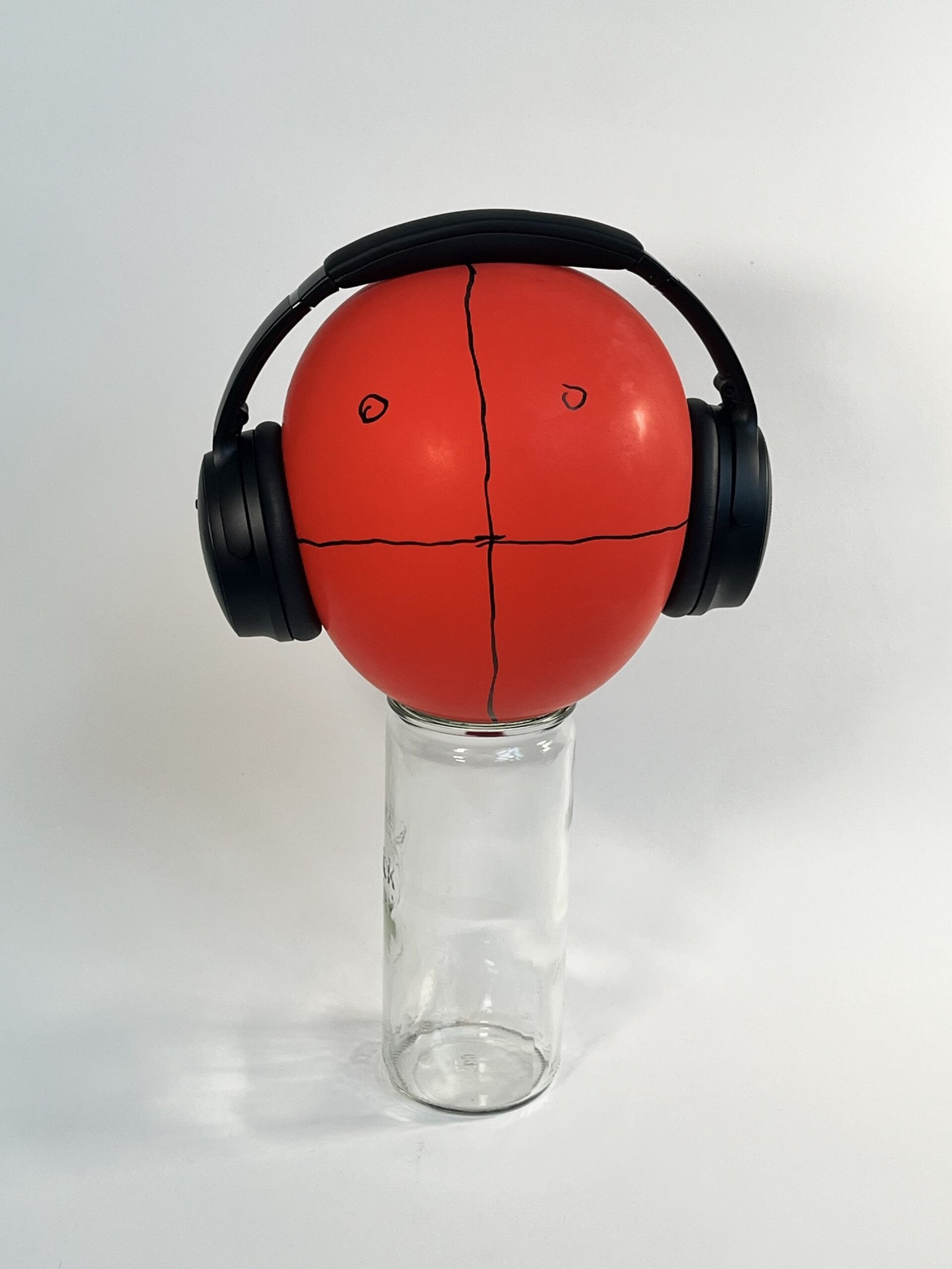
Clamp force is the squeeze a headband applies inward against the sides of your head. It’s the hardest thing to judge in a shop, because thirty seconds of wear tells you nothing. So the investigation uses a balloon as a head proxy: inflate to a fixed size, headphones placed as they’d sit on a head, and the compression measured. More compression means more force.
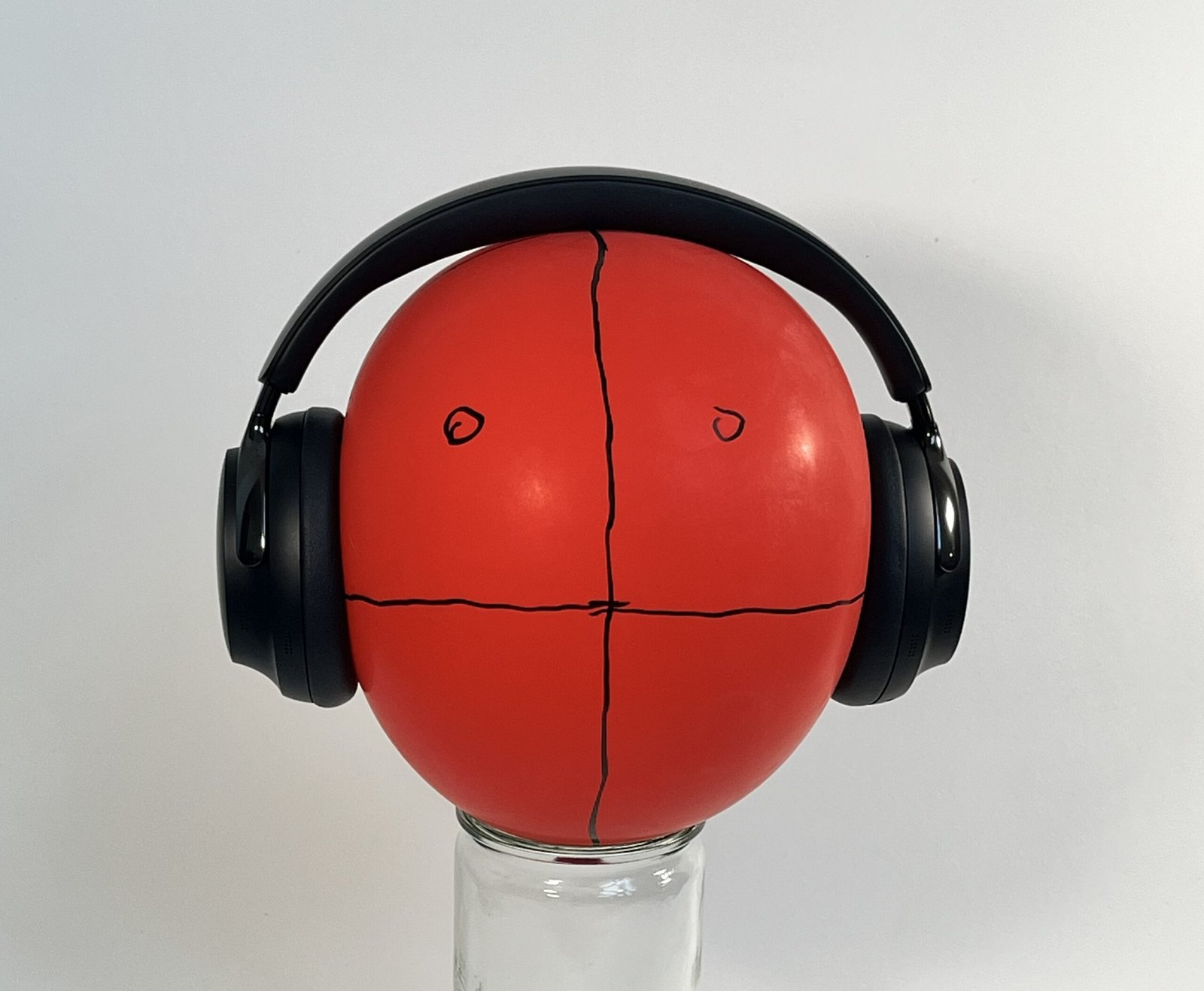
Read the two rows separately, because they don’t agree. On a large head the difference is substantial: the flagship squeezes nearly twice as hard, and it’s carrying an extra twenty six grams while it does it. On a small head the order flips, and the Ultra measured the gentler of the two. So if you have a smaller head this particular advantage isn’t yours, and the case for the older pair rests on pressure, self-noise and occlusion instead.
Clamp is also why glasses matter so much here. Spectacle arms sit exactly where the pad meets the skull, and every gram of squeeze goes through that thin piece of plastic into the side of your head. Less clamp, less of that. Across the four headphones tested the QuietComfort was the most comfortable in glasses, and on a large head the balloon numbers explain why.
Both units get hot, because any seal good enough to block sound is good enough to trap warmth. The QuietComfort runs the cooler of the two. Neither is cool.
Self-noise: how strong, and what kind
Every active canceller generates a faint noise floor of its own. Marketing calls the result silence. Sit in an actually silent room and you’ll hear the difference, because the cancellation has nothing left to work against and its own output becomes the loudest thing in your ears. What matters isn’t when you first notice it. It’s how strong it is, and what character it has, because a soft wash is liveable and a high pitched tone is not.
Self-noise scale, four steps: none / faint hiss / clear hiss / a tone. Scored by seated listening in a silent room with nothing playing.
That gap is the whole purchase for anyone who wants headphones on in a quiet house for reading or work. A tone gives your hearing something to lock onto, and once you’ve heard it you’ll keep hearing it. A soft wash sits under the threshold of attention and stays there. Neither unit is silent.
Neither pair seals you off completely, so birdsong through an open window is still audible with both.
Two glitches, one of them disqualifying
Both units do something unwanted when the world moves quickly. They aren’t equivalent, and the page shouldn’t pretend they are.
Road bumps
Cancellation whumps and cuts out entirely at every bump in the road. Many times a minute, in silent mode and with a signal playing. This makes the Ultra unusable on a bus, not merely worse.
Spoons and doors
A dropped spoon or a firmly closed door produces a brief pressure click, semi-painful in the moment. Occasional rather than constant, and it doesn’t stop you using them.
A teenager borrowed them for one ride to college and handed them back unimpressed. Several journeys with the Ultra confirmed it, and a second listener confirmed it again.
One more thing both share, and it’s worth saying plainly. Neither aware mode is worth using. On both units the transparency setting made the room stranger rather than clearer, and in every environment tested the better move was to take the headphones off. If you need to hear someone, take them off. Only the Sony WH-1000XM6 avoided both glitches, and its transparency mode was no more useful.
Triggers: where the flagship earns it
Cancellation alone, on other people’s mouths, the Ultra is the better product and it isn’t close. Chewing, lip smacking, the wet sounds that ruin a shared table. If that’s your trigger and you won’t wear a mask, this is the one place the extra money buys you something the older pair can’t match.
Add a masking sound and the advantage mostly dissolves. Both units handle mouth sounds well once something is playing, which is how most people actually use them. So the Ultra’s win is real but conditional, and the condition is that you’re sitting there with nothing on.
Occlusion runs the other way and it’s the finding people miss. Sealing the ear makes your own chewing and breathing louder, not quieter. The QuietComfort produced the least of it in this batch and the Ultra noticeably more, so if your triggers include your own body rather than everyone else’s, the ranking inverts completely. Same mechanism as earplugs, set out in the occlusion effect explainer.
Anyone choosing primarily for chewing sounds should read the earplug data before spending flagship money here. Start at best earplugs for misophonia. The rule this investigation keeps arriving at: silence favours the earplug, masking favours the headphone.
Room by room
Room‑by‑room differences matter, but long‑wear comfort decides the purchase, and that’s where the QuietComfort is consistently ahead.BOST verdicts: Cleared / Caution / Flagged. “Edge” indicates a meaningful advantage within the same band.
Quiet room
Close to level on what they block. The Ultra’s tone becomes noticeable in quiet rooms.
Home with appliances
Edge to the Ultra. It handled the washing machine better, and it took more out of voices carrying from another room. Kettle and extractor fan came out close to even. Neither result is dramatic, but on domestic machine noise the newer model won more praise.
Open plan office
Best result on the page for the older pair, and pressure is why. Ninety minutes at a desk is exactly the length of wear the QuietComfort is built for, and the Ultra’s inner ear pressure curve climbs into discomfort well before a morning shift is over. Neither helped filter out a colleague’s phone call: on both, cancelling the air-con hum makes voices more present rather than less, the same paradox the Loop Engage earplugs produce.
Bose QuietComfort
One of the most comfortable of the four tested while wearing glasses.
Purchased, not gifted. How this site makes money
Commute on a bus
On pure noise blocking these two are similar, and on nothing else. Ultra’s cancellation cuts out at every bump in the road, repeatedly, for the length of the journey. It is startling, irritating and fundamentally makes the journey less predictable and stressful.
Supermarket
Edge to the Ultra on raw cutting power in a genuinely loud room. Both demonstrate the same trap though: cancel the fridge hum and the store music comes forward, because the cancellation does nothing to it and the floor it was hiding behind has gone. Run a mask and both cope. On a depleted day the mask itself became the irritant, which is the honest limit of this whole approach.
Restaurant or café
Edge to the Ultra again, for the same reason. It takes more out of a loud room. Neither is a recovery tool, and neither lets you stay in the conversation, so a café with company defeats both. Foam earplugs blocked more and left stillness behind without requiring you to play anything, which matters when playing something is the last thing you want. Earplugs are the better instrument here.
Which one, for you
No hedging. Each profile gets one answer.
Buy the standard QuietComfort for anything that lasts an hour
Lowest eardrum pressure recorded in this investigation, confirmed on the bench, confirmed again under the 75 dB test, and confirmed in real noisy rooms. Weakest self-noise of the four, a soft wash rather than a tone. Least occlusion, so your own chewing and breathing stay where they belong. One of the gentlest clamp on a large head at 3.4 percent balloon compression, lightest of the four, coolest under the pads, and the most comfortable of the batch if you wear glasses. It also blocked more recorded music and speech in lab conditions than any of the four, from the cheapest unit in the batch. One caution: a dropped spoon or a slammed door produces a brief pressure click. If your head is on the smaller side, the clamp advantage doesn’t apply to you.
READ THE FULL QUIETCOMFORT CASE FILE →Buy the Ultra for mouth sounds, or for loud public rooms
Cancellation alone, it’s clearly the better product on other people’s chewing and lip smacking, and it’s the best of the four at it. In cafés and supermarkets it cuts more of a loud room away. With a masking sound running it needs the mask slightly quieter than the older pair does. Nicest object in the batch, best case, no smell at all on arrival, and the gentler of the two on a smaller head. Against all that: the cancellation cuts out at every road bump, which makes it unusable on a bus rather than merely worse. Higher ear pressure, heavier, hotter, and it slips when you tilt. Flagged, and not recommended for a commute at any price.
READ THE FULL ULTRA CASE FILE →The Sony WH-1000XM6
Some readers finish this page recognising themselves in neither profile. Startles are the trigger, which rules out the QuietComfort’s click. Or raw cancellation matters more than anything else, and neither Bose goes far enough. The XM6 finished first of the four on the tone grid and first in every live room, with no bump cutout and no pressure click. It costs more ear pressure than either Bose across ninety minutes, reaching 4 of 5 by the end, so it’s the wrong buy if that’s your limiting factor.
READ THE FULL XM6 CASE FILE →NEVER SPONSORED. NEVER GIFTED. Both units were bought at retail. Links are affiliate links and BOST may earn a commission at no extra cost to you, which has no bearing on any verdict. How this site makes money · How ANC headphones are tested
KEEP READING
 INVESTIGATION HUB
Noise cancelling headphones for autistic adults
Every case file, the method, and each comparison under one protocol.
INVESTIGATION HUB
Noise cancelling headphones for autistic adults
Every case file, the method, and each comparison under one protocol.
 FIELD REPORT
Sony XM6 vs XM5
The same comparison on the other flagship pair, including which one hurts less after an hour.
FIELD REPORT
Sony XM6 vs XM5
The same comparison on the other flagship pair, including which one hurts less after an hour.
 FIELD REPORT
Why sealing your ears makes your own body louder
The occlusion effect, and why it decides this comparison for some readers.
FIELD REPORT
Why sealing your ears makes your own body louder
The occlusion effect, and why it decides this comparison for some readers.
About this comparison. Both headphones were purchased, not gifted, and tested by one reviewer across the same six environments using the same protocol, the same tones, the same music and speech clips, and the same balloons. Results reflect a specific sensory profile and should be read accordingly. How the investigation tests ANC headphones.
Both headphones tested under the BOST ANC protocol: nine tones at three conditions, timed eardrum pressure across ninety minutes, balloon clamp proxies at two head sizes, live trigger sounds, and six real environments. How the investigation tests ANC headphones →