
Shampoo Ingredients to Avoid.
Eight products cross-referenced.
We found that even specialist ‘fragrance free’ and ‘natural’ shampoos are packed with irritants. Here is a plain-language guide to the eight most commonly reported chemical sensitivities in shampoo and which of our reviewed products contain them.
Ingredient data sourced from manufacturer INCI lists and verified against third-party databases.
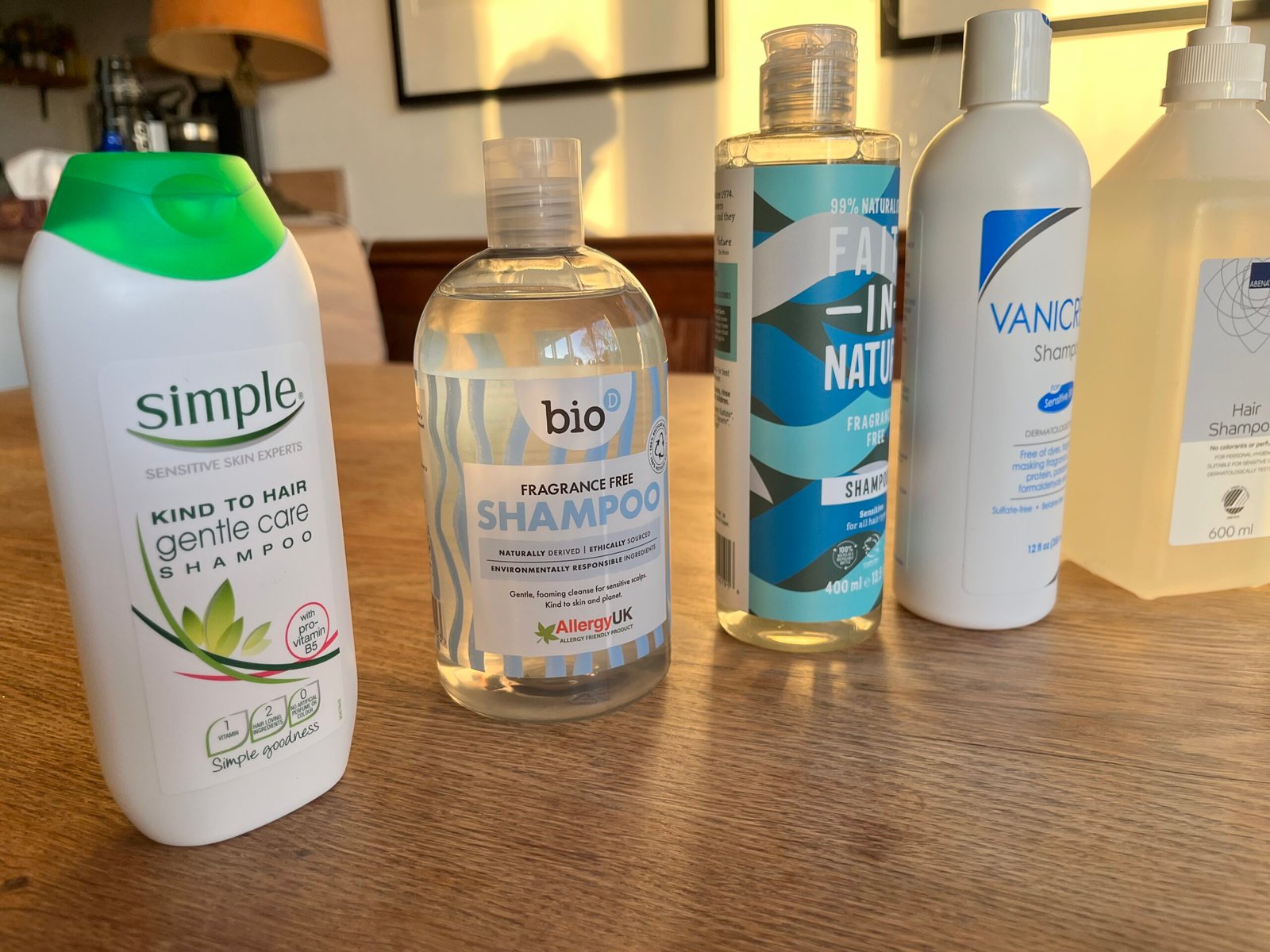
Knowing which shampoo ingredients to avoid for sensitive skin is harder than it looks. Most products labelled fragrance-free or natural still contain CAPB, sulfates, or botanical extracts that cause reactions in sensory-sensitive and autistic adults. This guide cross-references eight reviewed products against the eight most commonly reported sensitivities. For sensory testing results rather than ingredient data, see the full fragrance-free shampoo investigation.
What this is and what it isn’t
This guide covers sensitivity and intolerance in common US and UK shampoo products, not allergy diagnosis. Sensitivity means an ingredient causes discomfort, irritation, or a sensory reaction without necessarily involving the immune system. Allergy means an immune response. This distinction matters. If you have a confirmed allergy to a specific ingredient, do not rely on this guide alone. Patch test or consult a dermatologist. This guide is a starting point for narrowing down options, not a medical safety assessment.
Formulations change without notice. Ingredient lists are verified against manufacturer INCI data as of April 2026 and cross-checked against INCIDecoder, SkinSAFE, and direct product pages. Manufacturers regularly update formulas. Always check the label on the specific bottle you are buying, especially for Noughty which explicitly states its formulas update regularly.

Eight common shampoo sensitivities
A surfactant derived from coconut oil used as a secondary cleanser and foam booster. It is one of the most prevalent contact allergens in modern shampoo formulations, and among the most frequently cited ingredients in Reddit discussions on scalp and skin reactions to “gentle” or “fragrance-free” products. The sensitivity is well-documented in dermatological literature.
Who reacts: people with eczema, reactive scalp, or who have developed sensitisation after prolonged exposure. The allergy is often not immediate; sensitisation builds with repeated use, which is why reactions appear in products you have used successfully for months.
The current dominant preservative in cosmetics, replacing parabens as consumer preference shifted. Found in a very high percentage of “natural” and “fragrance-free” products because it is effective, stable, and paraben-free. It has a faint rose-like odour that is usually imperceptible at standard concentrations (up to 1%) but can contribute to the mild chemical note some sensitive users detect in shower steam.
Who reacts: people with general preservative sensitivity or contact dermatitis. Also noted by some users with phenol sensitivity, phenoxyethanol is a glycol ether structurally related to phenol. Reactions are typically localised (scalp irritation, itching) rather than systemic.
The primary cleansing agents in most conventional shampoos. SLS is the most aggressive, it strips the scalp’s natural oils efficiently and raises the hair cuticle, causing squeak on rinse. SLES is milder (ethoxylated version). ALS (Ammonium Laureth Sulfate) is used in Faith in Nature, comparable mildness to SLES. The concern for sensitive users is not usually allergy but irritation and barrier disruption with repeated use.
Who reacts: people with dry, eczema-prone, or already-compromised scalp skin. Also the primary cause of squeak on rinse for users with chemically sensitive or dry hair. Sulfate-free shampoos use glucosides or isethionates instead.
Plant-derived ingredients marketed as soothing or natural. They are the primary source of unexpected smell in fragrance-free shampoos. The investigation found that aloe, chamomile, oat extract, and geranium oil all release detectable scent compounds under heat and steam. For users with specific plant allergies (e.g. chamomile is a member of the Asteraceae family and cross-reacts with ragweed allergy), these ingredients can also cause true allergic contact dermatitis.
Who reacts: people with plant or pollen sensitivities (especially ragweed, chrysanthemum cross-reactors), people with balsam of Peru allergy, and people sensitive to heat-activated scent from botanical compounds. Note: Simple lists chamomile oil and geranium oil despite marketing as “no artificial perfume”, these are real botanical essential oils.
Preservatives that work by slowly releasing small amounts of formaldehyde to prevent microbial growth. Formaldehyde is a known sensitiser and listed allergen. Simple contains Sodium Hydroxymethylglycinate, a formaldehyde releaser that appears in some “natural” product formulations and is not always flagged as clearly on marketing materials. DMDM Hydantoin is the most commonly cited by name in online sensitivity discussions.
Who reacts: people with formaldehyde allergy, which is one of the most prevalent contact allergens tested by dermatologists. The reaction can be severe even at low concentrations. Formaldehyde releasers are increasingly absent from European and UK formulations but still appear in some products.
Preservatives that caused a significant contact allergy epidemic in Europe in the 2010s when MI was approved for use in rinse-off cosmetics at higher concentrations. Subsequently restricted. MI/MCI are now tightly regulated in the EU and UK and largely absent from mainstream shampoos, but they persist in some household cleaning products and older formulations. None of the eight reviewed products contain MI or MCI.
Who reacts: people who developed sensitisation during the epidemic of use (2010–2016) may still react at very low concentrations. If you know you are MI-allergic, this is a confirmed concern for the household cleaning space more than current shampoos.
A widely used preservative pair in “natural” and “free-from” formulations appearing in most of this batch as the replacement for parabens and MI. Sodium benzoate is a salt of benzoic acid and is listed in the EU’s 26 fragrance allergens because of its relationship to Balsam of Peru allergy. For most users it is innocuous; for users with Balsam of Peru sensitivity or salicylate intolerance it can cause reactions.
Who reacts: people with Balsam of Peru allergy (a well-established contact allergen group that includes cinnamon, vanilla, cloves, citrus peel and related compounds). Potassium sorbate is generally very well tolerated but can cause mild irritation in high concentrations.
A foam booster and viscosity builder derived from coconut oil. Listed on California’s Proposition 65 list as a possible carcinogen at high concentrations. It can be contaminated with nitrosamines (carcinogenic byproducts formed when DEA-based ingredients interact with certain other ingredients). The concern is more about long-term repeated use than acute sensitivity, but it is regularly cited in Reddit sensitivity discussions. Only Simple contains it in this batch.
Who reacts: people who have developed sensitisation to DEA-based compounds, or people avoiding Proposition 65 listed ingredients on precautionary grounds. The DEA reaction is also often cited alongside nitrosamine contamination concerns by users with chemical sensitivity.
Allergen table, scan by ingredient or product
| Product | CAPBCocamidopropyl Betaine | PhenoxyPhenoxyethanol | SulfatesSLS / SLES / ALS | BotanicalsAloe / Oat / EOs | Form. Rel.Formaldehyde releasers | MI / MCIIsothiazolinones | Sod. Benz.Sodium Benzoate | DEACocamide DEA |
|---|---|---|---|---|---|---|---|---|
| Abena | × | ✓ | × | ✓ | ✓ | ✓ | × | ✓ |
| Faith in Nature | × | ✓ | × | ✓ | ✓ | ✓ | × | ✓ |
| Vanicream | ✓ | ✓ | ✓ | ✓ | ✓ | ✓ | ✓ | ✓ |
| Noughty | × | × | ✓ | × | ✓ | ✓ | × | ✓ |
| Simple | × | ✓ | × | × | × | ✓ | × | × |
| E45 | ✓ | ✓ | × | ✓ | ✓ | ✓ | ✓ | ✓ |
| bio-d | × | ✓ | × | × | ✓ | ✓ | × | ✓ |
| Urtekram | ✓ | ✓ | ~ | × | ✓ | ✓ | ✓ | ✓ |
Urtekram ~ on sulfates: contains Sodium Coco-Sulfate, which is debated; some classify it as a sulfate, manufacturers typically do not. Treat as caution if sulfate-sensitive.
If you are avoiding multiple sensitivities
Vanicream is the only product in this batch free of all eight sensitivities. No CAPB, no phenoxyethanol, no sulfates, no botanicals, no formaldehyde releasers, no MI, no sodium benzoate, no Cocamide DEA. It uses a glucoside-based surfactant system (Lauryl Glucoside, Coco-Glucoside) and preserves with 1,2-Hexanediol and Caprylyl Glycol rather than more reactive preservatives. For users with multiple or unknown sensitivities, it is the most defensible starting point.
E45 also clears on CAPB, phenoxyethanol, botanicals, formaldehyde releasers, MI, sodium benzoate, and Cocamide DEA; but contains a sulfate (Sodium Myreth Sulfate) and Climbazole (an antifungal active not in the other products). If sulfates are tolerable, E45 has a comparable sensitivity profile to Vanicream.
Ingredient notes: each product
Abena
Very short ingredient list, eleven ingredients. Contains CAPB and SLES, which are common sensitisers, but is otherwise clean. No botanicals, no phenoxyethanol, no formaldehyde releasers. The sodium benzoate preservative is the only additional flag for Balsam of Peru-sensitive users. Best overall sensory performance in the batch.
Faith in Nature
Eight ingredients, even shorter than Abena. Contains Ammonium Laureth Sulfate (broadly comparable to SLES in mildness) and CAPB. No botanicals, no phenoxyethanol, no formaldehyde releasers. Sodium benzoate and potassium sorbate both present. Very clean for a UK retail shampoo at this price point.
Vanicream
The reference formula for chemical sensitivity in this batch. Sulfate-free, CAPB-free, no botanicals, no phenoxyethanol, no traditional preservatives. The glucoside surfactant system (Lauryl Glucoside, Coco-Glucoside) is well-tolerated by most reactive users. US-widely available. Note the ingredient list changed when the product was rebranded from “Free & Clear Shampoo” to “Vanicream Shampoo”, the formulation is the same.
Noughty Care Taker
Sulfate-free and phenoxyethanol-present (1% max). Also contains oat extract (Avena Sativa), bisabolol, and wheat amino acids, all potential botanical sensitivities. The oat extract is notable: oat-derived ingredients cause contact reactions in some users with oat allergy, a known issue in eczema skincare. Formulations are explicitly stated to update regularly, always verify the label.
Simple
The most flags of the batch: SLES, CAPB, Cocamide DEA, Sodium Hydroxymethylglycinate (formaldehyde releaser), chamomile oil (Anthemis Nobilis), and geranium oil (Pelargonium Graveolens). The botanical oils in particular contradict the “no artificial perfume” marketing, these are real essential oils that produce detectable scent under heat. For chemical-sensitive users, this is not the product.
E45
No CAPB, no phenoxyethanol, no botanicals, no formaldehyde releasers. Contains Sodium Myreth Sulfate (a sulfate by another name) and Climbazole (an antifungal preservative not found in other products). Climbazole is generally well-tolerated but some users with azole sensitivity may react. Medicated positioning,; not a daily shampoo for most users.
bio-d
SLES and CAPB present. Contains Aloe Barbadensis Leaf Juice as its botanical. Preserved with sodium benzoate and potassium sorbate. No phenoxyethanol, no formaldehyde releasers, no essential oils. The short ingredient list is broadly clean except for the CAPB and sulfate flags.
Urtekram
No CAPB, no phenoxyethanol, no formaldehyde releasers, no sodium benzoate. Contains aloe, Lysolecithin (soy-derived, relevant for soy-sensitive users), and Sodium Coco-Sulfate (debated sulfate status). The most botanical-forward formula in the batch. The aloe and fatty components are the primary source of the strong warm odour noted in the scent investigation.