
reviews for those who notice more
No sponsorship, no freebies. Links here earn a small commission at no extra cost to you, which keeps the investigations independent. More info
Abena Fragrance Free Shampoo Review
A genuinely low-scent, low-foam, and unusually calm in use. Cleans effectively without squeak. Still relies on sulfates.
This is a case report within Investigation No. 1 Fragrance-Free Shampoos. Findings relate to sensory behaviour: smell, texture, and in-shower experience. Not a clinical assessment.
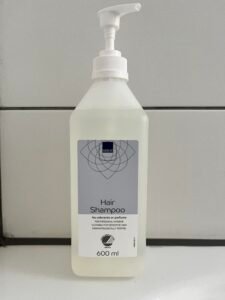
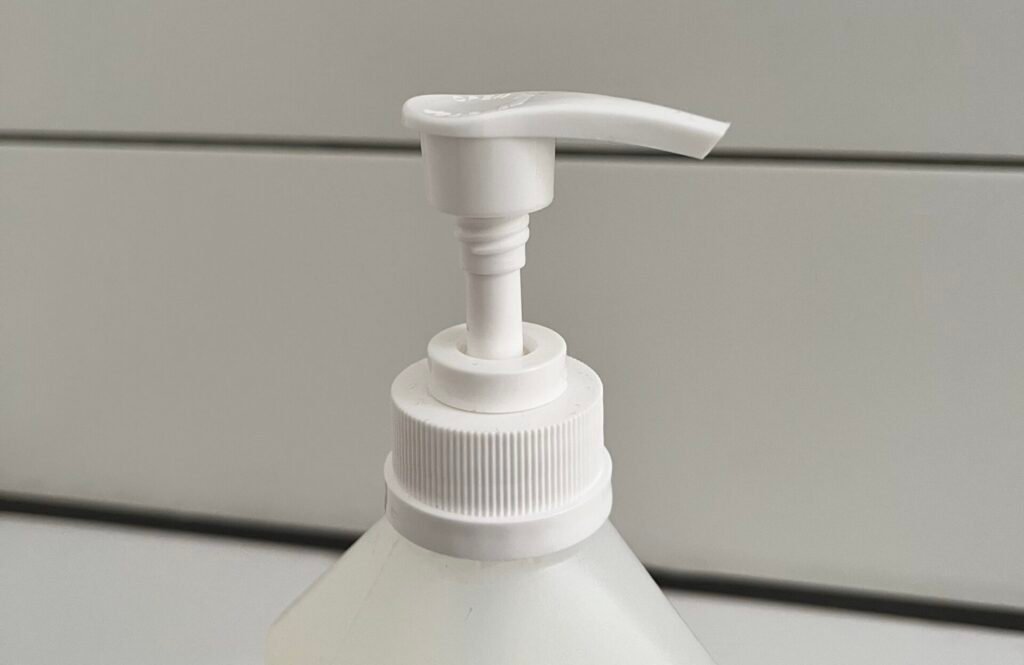
Fig. II — Exhibit A. 600ml pump. Institutional in origin.
Sensory scorecard
Smell and texture: the findings
This review examines two dimensions: smell and texture & behaviour.
This is one of the few fragrance-free shampoos tested that could reasonably be described as functionally unscented. No detectable smell from the bottle, no bloom in hot water, no residual smell on hair after drying. Any base soap note is so faint it requires deliberate attention to notice. This makes Abena a strong option if smell sensitivity is your primary trigger — particularly in hot showers, where many 'fragrance free' shampoos fail.

The gel forms light strings at the pump nozzle, which can look concerning at first. In use this doesn't translate into stickiness — the product behaves cleanly once in the hand. Foam is extremely minimal and controlled, rinsing is smooth with no squeaky-clean friction, and the pump format sidesteps every cap-related problem observed in this investigation. There is a suspicion the product gunks up on the nozzle over time.
Case notes
What was found

Abena is an institutional product — designed for hospitals and care settings rather than bathroom shelves. This turns out to be an advantage. The brief was clearly clean: effective, cause no trouble, smell of nothing. The formula satisfies all three, and does so without drama.
The institutional origin shows in the packaging — plain, large, practical — and in the formula, which contains no botanical extracts, no essential oils, and no added complexity. What it contains instead is a well-considered combination of a standard sulfate cleanser, two refatting agents that protect the hair surface after cleansing, and a conditioning polymer that leaves hair noticeably smooth after drying.
For users who tolerate SLES, this is one of the most sensory-acceptable options in the current investigation. For those who don't, it is the wrong product. Both things are true without contradiction.
The one standing question is the sulfate base. For users avoiding SLES on ingredient grounds — rather than sensory grounds — this product does not clear that bar. On every sensory measure, the investigation found little to report against it. If sulfates are the issue, Noughty and Vanicream are the alternatives in this investigation.
What was tested
The tests
A large, plain, white pump bottle. Utilitarian. The label is legible and uncluttered. A single firm press delivers a measured amount — no over-dispensing. No cap to open or close. The pump format avoids the squeak and product build-up that appeared with every flip-top bottle in this investigation.
The product dispenses as a clear, slightly viscous gel. On first press, a light string forms between the nozzle and the hand — this is normal behaviour for a gel of this viscosity and is not considered a problem in use. The string does not extend to the point of dripping or creating mess. It breaks cleanly. In the hand the gel is smooth, non-sticky, and spreads without resistance.
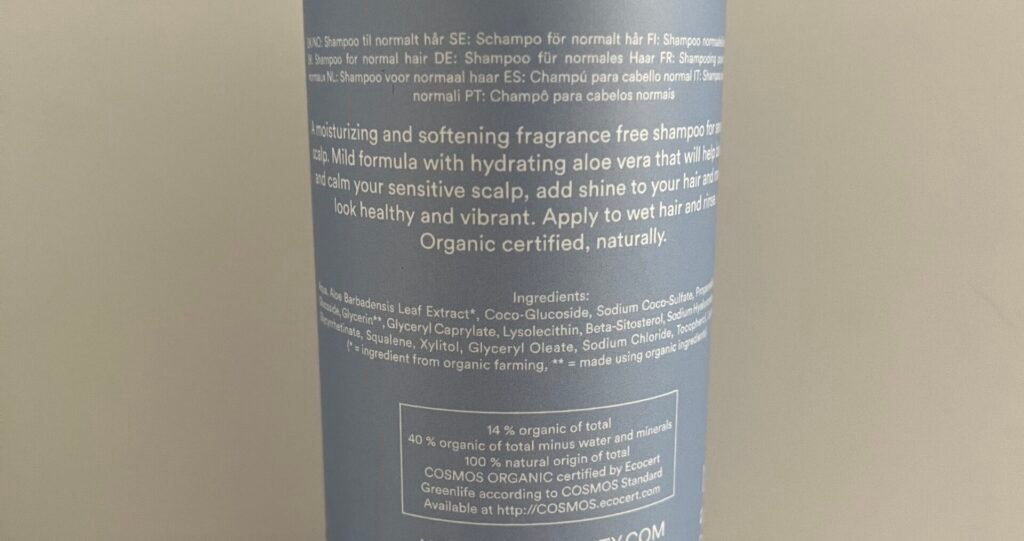
Product assessed at room temperature, directly from the pump and in the hand. No scent detected. No chemical or floral character at close range. This is notable — several products in this investigation had a detectable base note even before water contact.
Fixed amount of product added to a jar of warm water, shaken fifteen times, observed for two minutes. Approximately half the jar filled with small, quiet suds that settled evenly and quickly. No large or erratic bubbles. No foam climbing the sides. After two minutes, a thin settled layer remained.
This is, among the eight products tested, the lowest foam result observed.
pH measured using litmus paper. Result: approximately 6.0 — slightly acidic, close to the scalp’s natural pH range of 4.5–5.5. This is the lowest pH of any sulfate-based product in the current test set, and correlates directly with the squeak-free outcome observed in the shower stage. Lower pH tends to mean less risk of scalp itch for sensitive scalps and reduction in irritability.
Product applied to wet hands and worked into a lather without running water. Fine, low-volume lather — a thin, quiet foam that spread predictably. No stickiness or gloopiness. Slightly creamy. No residue between the fingers. Hands rinsed clean in a single pass. No film after drying.
Tested in hard water (South Downs chalk) at shower temperature. Product applied to wet hair from roots to ends and rinsed. Double amount required to get it to cover head.
Lather stayed quiet and low-volume, consistent with the jar test. It was thick, creamy and non-sudsy. No scent emerged under heat — not even faintly. Rinse was fast and clean. No squeak at any point. Hair did not feel stripped. No scalp tightness or itching during or after.
The following morning: hair felt clean, smooth, though not especially well conditioned. No delayed dryness or tightness. No residual odor detected.
No squeak at any point. Hair did not feel stripped. This makes Abena one of very few sulfate-based products in the squeak-free category — the refatting agents appear to be doing real work.
Claims checker
What the label says vs. what the test found
| The claim | Finding | Note |
|---|---|---|
| "Fragrance free" | | Minimal detectable scent. Without added fragrance, perfume, botanicals. |
| "Moisturising and Softening" | | Clean, smooth hair. Not stripped despite the sulfate base but not as conditioning as others. |
| "Easy to rinse, no residue" | | Fast, clean rinse. No residue on hair or hands. |
| "For sensitive skin" | | No fragrance, botanicals or colorants but SLES and CAPB are present — known irritants for some users. Tolerance may vary. |
| "Suitable for all hair types" | | A broad marketing claim. SLES is milder than SLS — but dry and curly hair may not tolerate daily SLES use. |
| "Anti-dandruff" | | No recognised anti-dandruff medication indicated. |
Ingredient analysis
Key points
- Key points — not a full INCI breakdown. Only what bears on the sensory outcome.
- Full list: Aqua, Sodium Laureth Sulfate, Glycerin, Cocamidopropyl Betaine, Glycereth-2 Cocoate, Betaine, Hydroxypropyl Guar Hydroxypropyltrimonium Chloride, PEG-4 Rapeseedamide, Citric Acid, Sodium Benzoate, Sodium Chloride.
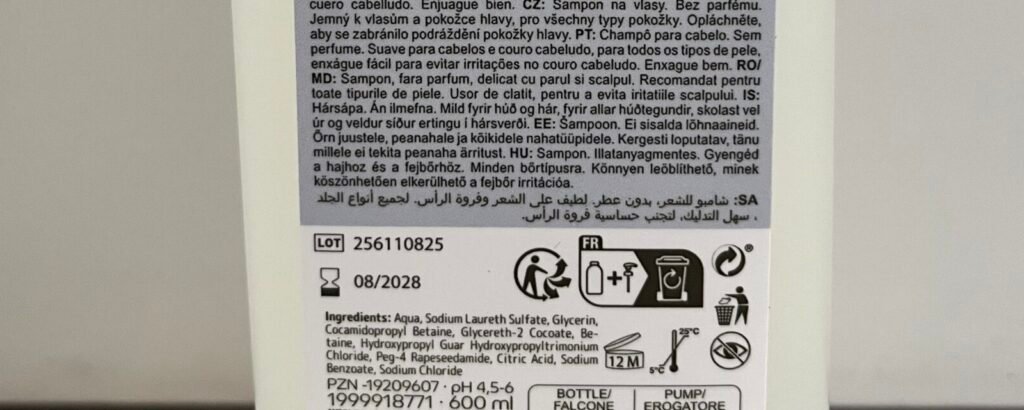
- Sodium Laureth Sulfate (SLES) Primary cleanser, but a sulfate. Normally associated with squeak — mitigated here by the refatting agents below.
- Cocamidopropyl Betaine (CAPB) Softens the cleanse but is a known contact allergen for some users with reactive or eczema-prone skin.
- Refatting agents (Glycereth-2 Cocoate, PEG-4 Rapeseedamide) Likely responsible for the lack of squeak despite the sulfate base. They replace the oils stripped by the cleanser, cushioning the rinse.
- Conditioning polymer (Hydroxypropyl Guar Hydroxypropyltrimonium Chloride) Improves slip and post-rinse feel without coating. An expensive ingredient — probably why hair feels better than most sulfate shampoos after drying.
- Citric Acid pH adjuster. Brings the formula to approximately pH 6 — helps keep the hair cuticle flat on rinse, reducing friction.
- Glycerin + Betaine These humectants can leave hair feeling soft and pliable immediately after washing, particularly on finer hair.
- No silicones Hair is unlikely to feel slick or artificially smoothed – with a natural, lightweight finish, with manageability coming from conditioning polymers rather than surface coating.
Verdict
Who this suits and who it doesn’t
 Works well if avoiding
- Fragrance and smell including in hot water and steam
- Foam, suds, and unpredictable lather
- Squeaky-clean friction on rinse
- Cap noise and product build-up
- Stripped and dry feeling after washing
Not right if you need- A sulfate-free formula (this contains SLES)
- To avoid CAPB, present here, known irritant
- A medicated or anti-dandruff shampoo
- A zero-string dispensing experience
- Rich conditioning for dry or curly hair
Abena stands out in this test set for achieving something most “fragrance-free” shampoos fail at: it is functionally unscented, including in hot water and steam, with a low-foam wash and no squeaky rinse-out. From a sensory perspective, this makes it one of the most acceptable shampoos tested.
However, this experience comes from predictable formulation choices, not extra gentleness. The shampoo still relies on SLES and CAPB, which means it will not suit everyone with sensitive or compromised scalps, and it should not be mistaken for a medicated or sulfate-free option.
Abena is the most sensory-neutral product in the current fragrance-free shampoo investigation. It is the correct starting point for anyone whose primary concern is smell. Those for whom the sulfate question is decisive should see Vanicream (sulfate-free, stronger clean) or Noughty, which introduces botanical complexity in exchange for a richer formula. For a full sensitivity cross-reference across all eight products, see the ingredient sensitivity guide.